
What Is a B2B Lending Platform? How They're Actually Built and Regulated in 2026
B2B lending platforms in India operate under strict RBI rules governing lender roles, fund flows, and co-lending. Here's how they actually work in 2026.
A B2B lending platform is typically described as software that matches borrowers with lenders. That's true, but it skips the part that actually determines how one is allowed to operate in India: every B2B lending platform sits inside a specific set of legal roles defined by the RBI, and what the platform can and can't do, how it shows offers, how money moves, who bears default risk, is spelt out in regulation rather than left to product design.
This guide breaks down what a B2B lending platform actually is once you look past the marketing definition: the regulatory roles every platform operates within, how multi-lender marketplaces are specifically governed, how money is allowed to move between borrower and lender, and how risk-sharing arrangements like co-lending work behind the scenes.
TL;DR:
Every B2B lending platform in India operates within three defined regulatory roles: the Regulated Entity (RE, the actual licenced lender), the Lending Service Provider (LSP, the platform facilitating the loan), and the Digital Lending App (DLA), all governed by the RBI (Digital Lending) Directions, 2025.
Platforms that show borrowers offers from multiple lenders are specifically regulated under Paragraph 6 of these Directions, which mandates an unbiassed display of all matching offers and bars promoting one lender's product over another.
Loan disbursal must flow directly between the RE and the borrower's bank account; platforms are barred from routing funds through pooled accounts, with narrow exceptions for co-lending and specific end-use disbursals.
Behind many platform-facilitated loans sits a co-lending arrangement between a bank and an NBFC, now governed by the RBI (Co-Lending Arrangements) Directions, 2025, effective January 1, 2026, which mandate minimum retention, blended interest rates, and borrower-level risk classification.
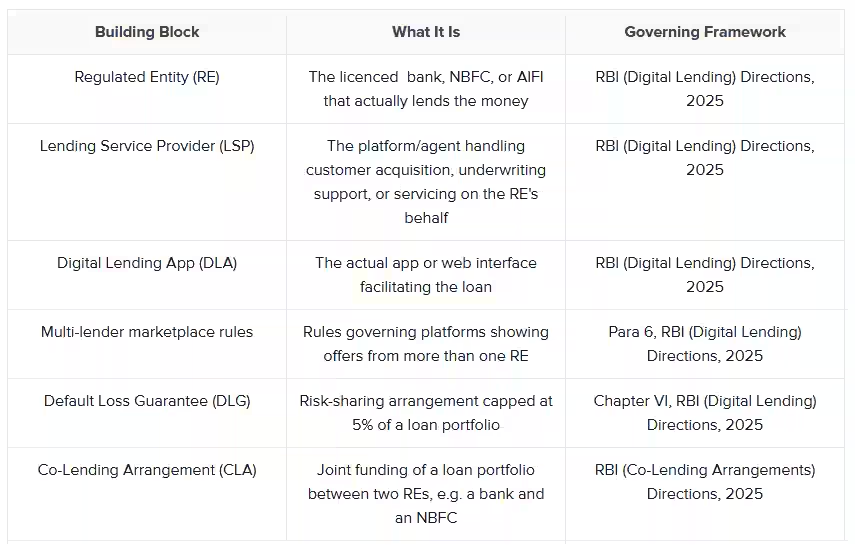
The Building Blocks of a B2B Lending Platform
Each row in the table below is explained in depth further down, including why the rule exists and what it changes in practice.
What a B2B Lending Platform Actually Is
Before looking at how platforms are regulated, it helps to be precise about what "platform" legally means, since it's easy to assume a fintech lending app is itself the lender.
The Three Regulatory Roles Every Platform Sits Within
The RBI's framework defines digital lending as a remote, largely automated process covering customer acquisition, credit assessment, approval, disbursement, and recovery. Within that process, three roles matter. The Regulated Entity (RE) is the commercial bank, co-operative bank, NBFC, or All-India Financial Institution that is actually licenced to lend and carries the loan on its books.
The Lending Service Provider (LSP) is an agent, which can even be another RE, engaged to carry out one or more of the RE's digital lending functions, such as customer acquisition, underwriting support, servicing, monitoring, or recovery. The Digital Lending App (DLA) is the actual mobile or web interface used to deliver these services, whether owned by the RE directly or by its LSP.
Why "Platform" and "Lender" Are Legally Different Things
A B2B lending platform typically operates as an LSP rather than an RE. This distinction carries real weight: an RE cannot dilute or transfer away its regulatory obligations by outsourcing functions to an LSP and remains fully responsible and liable for everything the LSP does on its behalf, including due diligence on the LSP's technical capability, data privacy practices, and conduct with borrowers before entering any agreement.
In practice, this means a platform connecting a business to 100+ lenders isn't itself the entity your business owes money to; it's facilitating access to REs who are.
Understanding this role split matters because it directly shapes how a platform is allowed to behave once more than one lender is involved.
How Multi-Lender Marketplace Platforms Are Regulated
Marketplace-style B2B lending platforms, ones that match a business against several lenders rather than originating loans themselves, fall under a specific paragraph of the Digital Lending Directions written precisely for this model.
The Digital Lending Directions' Rules for Showing Borrowers Multiple Offers
Where an LSP has agreements with multiple REs, Paragraph 6 of the RBI (Digital Lending) Directions, 2025 requires the platform to provide a digital view of all loan offers matching the borrower's request, including the names of unmatched lenders.
The displayed offers must include each RE's name, loan amount and tenor, APR, monthly repayment obligation, and applicable penal charges, laid out in a way that lets the borrower make a fair comparison, along with a link to each RE's Key Fact Statement.
Why Platforms Can't Just Push One Lender's Product
The same paragraph explicitly bars content that is biassed or that directly or indirectly promotes a particular RE's product, including through dark patterns designed to mislead borrowers toward one offer.
A platform can rank offers using a publicly pre-disclosed metric without that counting as promotion, but the underlying matching mechanism and any changes to it must be documented and applied consistently to similarly placed borrowers. This is the regulatory backbone that makes an actual lender-comparison marketplace legally distinct from a single lender's app dressed up to look like one.
Once a business has compared and chosen an offer, the next layer of regulation governs what happens to the money itself.
How Money Actually Moves: Disbursal, Repayment, and Fee Rules
The mechanics of fund flow are one of the more tightly regulated parts of the framework, largely because pooled intermediary accounts were a major source of past disputes and opacity in digital lending.
Loan disbursal by the RE must go directly into the borrower's bank account, with narrow exceptions: statutory or regulatory mandates, the flow of funds between REs in a co-lending transaction, and disbursals for a specific end use where the funds still land directly in the end beneficiary's account.
Disbursement to any third-party account, including an LSP's, is not permitted outside these exceptions. Repayment works the same way in reverse: borrowers must repay directly into the RE's account without a pass-through or pool account of any kind, and the flow of funds cannot be controlled, directly or indirectly, by a third party such as the LSP. Any fees owed to the LSP must be paid by the RE itself, never charged to or collected from the borrower separately.
One narrow allowance exists for delinquent loans: REs may use physical recovery agents to collect cash when necessary, provided the amount is credited to the borrower's account the same day.
These rules govern a single loan from a single RE. Behind many platform-facilitated loans, though, sits a second layer of structure: two REs jointly funding the same loan.
Risk-Sharing Behind the Scenes: DLG and Co-Lending
Two distinct risk-sharing mechanisms sit underneath much of India's B2B lending infrastructure, and they solve different problems.
Default Loss Guarantee (DLG): What It Covers and Its 5% Cap
A Default Loss Guarantee is a contractual arrangement in which an entity, typically the LSP or another RE acting as one, agrees to compensate the RE for losses up to a specified percentage of the loan portfolio. Under the Digital Lending Directions, an RE can enter into a DLG arrangement only with an LSP incorporated as a company or with another RE, and the guarantee is capped at 5% of the amount disbursed from that portfolio at any given time.
DLG must take the form of cash, a bank guarantee, or a fixed deposit with a lien in the RE's favour, must be invoked within 120 days of default, and once invoked, cannot be reinstated even through later recovery. Government-backed schemes such as CGTMSE are explicitly excluded from this definition, so they operate under their own separate framework rather than as a DLG.
Co-Lending Arrangements: How Banks and NBFCs Split a Loan
A Co-Lending Arrangement (CLA) is different from a DLG: instead of one entity guaranteeing another's losses, two REs, typically a bank and an NBFC, jointly fund the same loan portfolio in a pre-agreed proportion, sharing both revenue and risk.
Under the RBI (Co-Lending Arrangements) Directions, 2025, effective January 1, 2026, each RE in a CLA must retain a minimum 10% share of every individual loan on its own books, down from the 20% NBFC-side retention required under the earlier 2020 framework.
The interest rate charged to the borrower is a blended rate, a weighted average of each RE's own rate based on their funding share, and this blended rate, along with any fees, must be disclosed in the Key Fact Statement. Loan shares must be reflected in both REs' books within 15 calendar days of disbursement, transactions are routed through an escrow account, and asset classification is applied at the borrower level: if either RE flags an account as a Non-Performing Asset, the other must apply the same classification.
This is precisely the kind of structure that lets a B2B lending platform offer a business a single loan that's actually funded jointly by a bank's lower cost of capital and an NBFC's faster underwriting reach.
Both mechanisms exist to manage risk between REs and their partners, but they translate into concrete protections and disclosures for the business borrowing through the platform.
What This Means for a Business Borrowing Through a Platform
For a founder or finance lead evaluating offers on a B2B lending platform, this regulatory architecture manifests in a few practical ways. Every offer must come with a Key Fact Statement disclosing the APR, total cost, and, if the loan involves co-lending, the blended interest rate, before the loan is sanctioned, not buried in fine print afterwards.
A cooling-off period, determined by the RE's own board policy but never less than one day, allows a borrower to exit a loan by repaying only the principal and the proportionate APR, without penalty, immediately after signing. Grievance redressal contacts must be published on the RE's, the LSP's, and the platform's interfaces, with an escalation path to the RBI's Complaint Management System if a complaint remains unresolved.
And because REs remain fully liable for their LSPs' conduct regardless of how a loan was sourced, a business working with a well-governed platform is, in effect, benefiting from the due diligence the RE is already required to have done.
For a broader look at B2B lending from a borrower's perspective, this guide covers the loan types and process end-to-end for startups and SMEs, and this comparison of fintech lending startups looks at how different platform models approach speed and underwriting.
FAQs
1. Is a B2B lending platform itself the lender, or just a facilitator?
In most cases, the platform operates as a Lending Service Provider facilitating access to a Regulated Entity, the actual bank, NBFC, or financial institution that lends the money and carries the loan on its books. The platform doesn't hold the loan itself; it connects the business to the entity that does.
2. Can a platform show only its preferred lender's offer instead of comparing several?
If a platform has agreements with multiple REs, it's required to display all matching loan offers in an unbiassed way, including disclosing unmatched lenders, rather than steering borrowers toward one product through biassed content or dark patterns designed to mislead them.
3. Where does my loan repayment actually go if I borrow through a platform? Repayments must go directly into the lending RE's bank account, never into a pooled or pass-through account controlled by the platform or any other third party. This direct-flow requirement exists specifically to prevent opacity around where borrower funds actually sit.
4. What is a Default Loss Guarantee, and does it affect my loan terms?
A DLG is a risk-sharing arrangement where an LSP or another RE guarantees to cover a portion of losses on a loan portfolio, capped at 5%. It's a backstage arrangement between the RE and its guarantee provider, and doesn't change your loan agreement or repayment obligations as a borrower.
5. What's the difference between co-lending and a Default Loss Guarantee?
Co-lending means two REs jointly fund your loan upfront and both carry a share of it on their books. A DLG is different: one entity separately guarantees to cover a portion of losses on a portfolio, without necessarily co-funding the loan itself.
6. If my loan is co-lent between a bank and an NBFC, whose interest rate applies? Neither rate applies individually. You're charged a blended rate, a weighted average of each RE's own rate based on their respective funding share, and this blended rate must be disclosed to you in the Key Fact Statement before you sign.
7. How long is the cooling-off period on a loan taken through a digital lending platform? It's determined by the lending RE's own board policy, but regulation sets a minimum of 1 day during which you can exit the loan by repaying only the principal and the proportionate APR without penalty, though the RE may retain a reasonable one-time processing fee for that exit.
8. Can a platform charge me a separate fee on top of what the lender charges?
Any fees owed to the platform (as an LSP) for its role in the loan must be paid by the RE itself, not charged to or collected from you separately. Whatever fees do apply to you must be built into the Annual Percentage Rate and disclosed upfront.
9. What happens if I have a complaint about a loan I took through a platform?
The RE remains fully responsible for resolving it, regardless of whether the platform or the RE directly handled your interaction. If your complaint isn't resolved within 30 days or you're unsatisfied with the response, you can escalate it through the RBI's Complaint Management System.
10. Does using a B2B lending platform mean my loan is less regulated than a direct bank loan?
No. The lending RE remains fully liable for its LSP's conduct under the Digital Lending Directions and cannot dilute its regulatory obligations by outsourcing customer-facing functions to a platform. The underlying loan is subject to the same regulatory protections either way.
Related Articles
Common Business Loan Terms Every Indian Founder Should Know
Common business loan terms explained by stage, application, pricing, security, repayment, with real examples, RBI rules, and a quick-reference glossary.

SME Loans in Chennai: 2026 Guide to Financing
SME Loans in Chennai: from TIIC and NEEDS to CGTMSE-backed private lending, matched to your cluster, whether Oragadam, Ambattur, or OMR.

Term Loans for Business Expansion: A Complete Guide
Choose the right term loan structure for business expansion in India, from equipment loans to large-project financing.
Talk to our experts and find the right financing solution.
Talk to Our Experts →