
Term Loans for Business Expansion: A Complete Guide
Choose the right term loan structure for business expansion in India, from equipment loans to large-project financing.

Expansion capital isn't one-size-fits-all. Opening a second facility, buying equipment, and entering a new state all need funding that behaves differently, even if the total amount looks similar on paper. A term loan is usually the right instrument for all three, but picking the wrong tenure, moratorium, or security structure can leave a business repaying faster than the expansion itself starts generating returns.
Most explanations of business expansion loans stop at definitions and document checklists.
This guide goes further, into how lenders actually underwrite an expansion term loan behind the scenes, including the distinction between greenfield and brownfield projects, the debt service coverage ratio math that decides how much you can actually borrow, and how to structure tenure and moratorium so repayment doesn't outrun your revenue ramp.
TL;DR:
Term loans suit expansion because they provide a lump sum upfront with a fixed repayment schedule, matching how most expansion costs (equipment, facilities, market entry) are actually incurred.
Lenders underwrite greenfield expansions (entirely new facilities or markets) very differently from brownfield expansions (scaling something that already works), often requiring an independent technical study for the former.
The Debt Service Coverage Ratio, typically expected to be 1.25 or higher, is the metric that determines how large a loan your expansion can support, not just your revenue size.
India's revised MSME classification, effective April 1, 2025, has widened eligibility for many growing businesses by raising investment and turnover thresholds.
Matching tenure and moratorium to the time it takes the expansion to ramp up matters more than chasing the lowest headline rate alone.
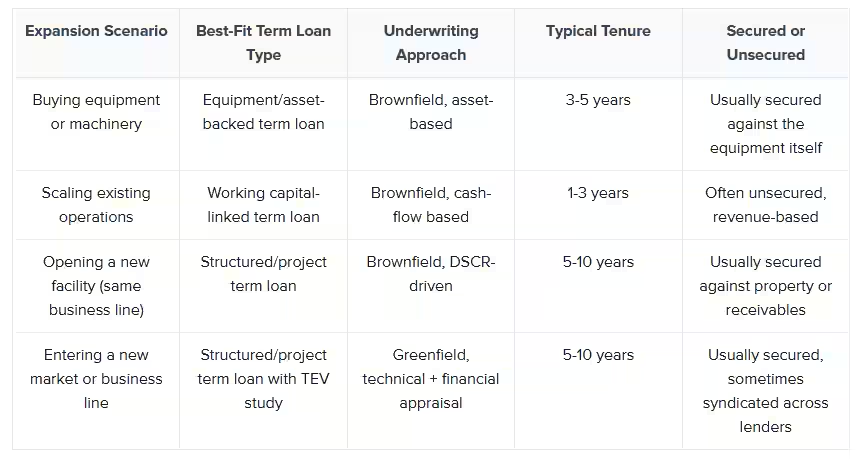
Quick Reference: Matching Expansion Scenarios to Term Loan Types
Use this table to orient yourself before reading further. Each row is explained in more depth in the sections below, including why the underwriting approach, tenure, and security columns look the way they do.
Why Term Loans Are the Default Instrument for Business Expansion
Expansion costs tend to be upfront and lump-sum in nature: a machine is bought outright, a lease deposit is paid in full, a new market entry needs a marketing and hiring budget before revenue follows.
A term loan matches this pattern by disbursing the full amount at once and spreading repayment over a fixed period, rather than offering revolving access the way a working capital facility does.
Matching Repayment Structure to the Investment Curve
The real reason term loans dominate expansion financing isn't just convenience; it's that repayment structured over years aligns with revenue that also builds over time. A working capital facility repaid on a short revolving cycle would force a business to service a long-payoff investment on a timeline the investment itself can't yet support.
A term loan, with its fixed schedule, can be structured, through tenure and a moratorium, to track how the expansion's returns unfold.
When a Term Loan Isn't the Right Fit
Not every expansion should be debt-funded through a term loan. A pre-revenue market entry has no operating income, so there's no denominator to test against in a DSCR calculation; DSCR-based underwriting simply can't apply to a business that hasn't yet started generating cash flow from the activity being funded.
In that situation, equity, venture debt, or a blended structure that layers a smaller term loan on top of internal cash often fits better until the expansion has some operating history. This is worth flagging upfront, since a mismatched term loan taken too early is precisely what creates the repayment strain covered further down.
Types of Term Loans Used for Business Expansion
Not every expansion calls for the same loan structure. The purpose of the capital determines which tenure, security, and repayment pattern actually fit.
Equipment and Machinery Term Loans
These loans fund a specific asset purchase, and the equipment itself typically serves as collateral. Tenure usually runs 3-5 years, and it's not an arbitrary range: lenders generally set it to track the asset's depreciation schedule, so the loan doesn't outlive the collateral's usable value.
If the machinery is fully depreciated in year four but the loan runs for six years, the lender is left holding security that's worth less than the outstanding balance for the final stretch, which is why tenure rarely exceeds the asset's working life.
Rates tend to be lower than unsecured alternatives since the lender has a recoverable asset to fall back on, and underwriting here is comparatively light: the asset itself does much of the risk-reduction work.
Working Capital-Linked Expansion Loans
Some expansions, like scaling an existing sales team or increasing inventory ahead of demand, don't need a single large asset purchase but still require a lump sum to get started.
These loans are priced closer to a business's revenue and cash flow strength than to any pledged asset, precisely because there's no single durable asset to size the loan against; a sales hire or a marketing push doesn't sit on a balance sheet the way machinery does.
That's also why tenure stays shorter, typically 1-3 years: without a depreciating asset setting a natural repayment horizon, lenders default to a shorter window that they can re-underwrite sooner if the business's revenue trend changes.
Structured or Project Term Loans
Larger moves, such as opening a new facility or entering a new geographic market, usually call for a structured term loan with a 5-10-year tenure. These are typically secured against property, receivables, or a combination of assets, and lenders often build in a moratorium period while the new facility or market ramps up to revenue. This is also where the underwriting approach starts to diverge sharply, depending on whether the expansion is greenfield or brownfield.
How Lenders Actually Underwrite an Expansion Term Loan: Greenfield vs Brownfield
Not all expansions carry the same risk in a lender's eyes, even at an identical loan amount. The single biggest factor is whether the business already has a track record behind the specific activity being expanded.
Greenfield Expansion and the TEV Study
A greenfield expansion, entering an entirely new market, product line, or building a facility from scratch, has no operating history for the lender to underwrite against.
Because of this, lenders commonly require a Techno-Economic Viability (TEV) study: an independent appraisal that validates the technology, capacity assumptions, market demand, and cost projections before debt is sanctioned.
This isn't a formality; a poorly prepared TEV study, or one commissioned too close to the loan deadline, is among the more common reasons a greenfield expansion loan is delayed or restructured under tighter conditions.
Brownfield Expansion and Why It's Priced Differently
A brownfield expansion, scaling a facility, product line, or market the business already operates in, carries a fundamentally different risk profile.
The lender can see real revenue, real margins, and real repayment conduct from the existing operation, and can underwrite the incremental investment against a business that already works.
This usually translates into a lighter appraisal, a stronger starting DSCR, faster sanction timelines, and fewer attached conditions than a comparable greenfield loan of the same size.
Debt Service Coverage Ratio: The Number That Decides Your Loan Size
Whether greenfield or brownfield, the Debt Service Coverage Ratio (DSCR) is the metric that most directly determines how large a loan a business can actually support. DSCR is calculated by dividing operating income (typically EBITDA) by total debt service, meaning principal plus interest due in that period. Most Indian lenders look for a DSCR of at least 1.25, meaning the business generates 25% more operating income than it needs to cover debt payments, with anything closer to 1.5 or higher considered a comfortably strong position.
Here's why this matters more than revenue size alone: a business with strong current-year revenue but a large new debt obligation layered on top can still show a weak DSCR if the new debt service is sized against income the expansion hasn't generated yet. This is exactly the gap that tenure and moratorium structuring, covered further down, are designed to manage.
Eligibility: Classification, Vintage, and Existing Leverage
Beyond the underwriting approach and DSCR, a handful of structural eligibility factors shape what a business can actually access, and these shifted meaningfully in 2025.
The 2025 MSME Classification Change and What It Unlocks
Under a Ministry of MSME notification effective April 1, 2025, investment and turnover limits for MSME classification were raised by 2.5 times and 2 times, respectively, and the credit guarantee cover for micro and small enterprises increased from ₹5 crore to ₹10 crore. This means a growing business that would previously have outgrown its MSME status and the associated access to guaranteed credit can now retain that status and the financing benefits attached to it for longer as it expands.
For smaller-ticket expansions, government-backed schemes such as CGTMSE can also extend collateral-free credit guarantee cover, which is worth checking before assuming a secured structure is the only option.
Vintage, Credit Score, and Existing Debt Exposure
Beyond classification, lenders look at how long the business has operated profitably, its credit score, and the amount of existing debt it carries. This isn't a separate checklist, but rather one that feeds directly into the DSCR math covered earlier.
Every EMI a business is already paying on prior loans gets added to the debt service side of the DSCR calculation, which means a business carrying meaningful existing debt has less headroom before a new expansion loan pushes its DSCR below the 1.25 threshold.
Two businesses with identical revenue can look very different to a lender if one is already servicing significant debt and the other isn't; the one with more headroom can typically support a larger new loan, or the same loan at better terms.
Structuring the Loan: Tenure, Moratorium, and Security
Once a business qualifies and understands how it will be underwritten, the actual structuring decisions, tenure, moratorium, and whether to secure the loan are what determine whether the financing actually fits the expansion in practice.
Matching Tenure and Moratorium to the Ramp Curve
Consider a business taking a ₹3 crore structured loan at 12% to open a new facility expected to reach full capacity in 18-24 months. If the loan is priced with no moratorium on a 5-year tenure, annual debt service (principal plus interest) works out to roughly ₹83 lakh.
In year one, while the facility is still ramping and generating only around ₹40 lakh in incremental EBITDA, the DSCR would be roughly 0.48, well below the 1.25 threshold lenders expect, and would likely constitute a covenant breach on day one.
Now structure the same loan with a 12-month, interest-only moratorium. Debt service in year one drops to roughly ₹36 lakh, with interest alone accounting for ₹ 36 lakh.
Against that same ₹40 lakh in ramp-year EBITDA, DSCR comes out to roughly 1.1, still tight but far closer to viable. By year two, once the facility is closer to full capacity and generating something closer to ₹1.5 crore in incremental EBITDA, full principal-and-interest debt service of ₹83 lakh produces a DSCR of roughly 1.8, a comfortably strong position.
The moratorium doesn't change the total interest cost by much, but it changes whether the loan survives its own ramp-up period.
Secured, Unsecured, or Blended: Matching Structure to the Asset
A secured expansion loan, backed by property, equipment, or receivables, usually unlocks a lower rate and a larger loan amount, since the lender's risk is offset by a recoverable asset.
An unsecured expansion loan skips that requirement but typically caps out at a smaller amount and a higher rate, priced instead on revenue strength and credit history.
For larger expansions, businesses don't always have to choose a single structure. Consider a ₹5 crore facility expansion: instead of taking the full amount as one secured loan against the new property, a business could structure ₹3 crore as secured debt against the facility itself, capturing the lower rate that collateral unlocks, and the remaining ₹2 crore as unsecured working capital priced on cash flow, avoiding a lien on the core asset for the full amount.
This matters because a lender's appetite to lend against a single asset usually caps out well below its full value, often in the 60-75% range depending on the asset type, so the unsecured portion often isn't optional padding; it's the only way to reach the full ₹5 crore without over-leveraging the property.
The same logic extends to syndication: for a large enough project, spreading the loan across two or three lenders can unlock a bigger total facility than any single lender's exposure limit to that business would otherwise allow. This is more common for structured project loans above a certain ticket size than for smaller, single-purpose equipment loans.
How to Apply for a Term Loan for Business Expansion
Once you've matched the loan type, underwriting approach, tenure, and security structure to your expansion plan, applying comes down to six steps.
Step 1: Classify your expansion as greenfield or brownfield.
This determines the appraisal you'll need. A brownfield expansion (scaling something the business already does) moves faster with a lighter appraisal. A greenfield expansion (a new market, product line, or facility) will need a Techno-Economic Viability study, so plan for that timeline upfront rather than discovering it mid-application.
Step 2: Run your own DSCR check before approaching a lender.
Estimate your operating income against the likely debt service on the loan amount you're considering, including during the ramp-up period, not just once the expansion is fully live. If the ramp-year number comes out below 1.25, you already know you'll need a moratorium built into the structure, and can ask for it upfront instead of negotiating it after a lender pushes back.
Step 3: Gather the core financial documents.
Lenders will ask for financial statements, GST returns, and bank statements, typically covering the last 12-24 months. This document checklist for business expansion term loans covers the full list and how far in advance to start organizing it.
Step 4: Prepare expansion-specific paperwork.
Beyond standard financials, have a clear business plan for the expansion itself, collateral documents if the loan will be secured, and, for greenfield projects, the TEV study or a mandate to commission one before submission.
Step 5: Compare loan structures, not just headline rates.
Get tenure, moratorium terms, and secured-vs-unsecured (or blended) options from more than one lender where possible. The cheapest quoted rate on a mismatched tenure can cost more in repayment strain than a slightly higher rate structured correctly against your ramp curve.
Step 6: Finalize the loan and confirm the disbursement schedule.
For larger structured or project loans, disbursement often happens in tranches tied to project milestones rather than as a single lump sum. Confirm this schedule matches your actual spending timeline before signing, so you're not paying interest on funds sitting idle ahead of when you need them.
Recur Club's capital experts help founders work through this sequence, greenfield or brownfield, matching the tenure, moratorium, and security terms to the growth plan across a network of institutional lenders rather than a single lender's fixed product menu.
FAQs
1. What's the difference between a term loan and a working capital loan for expansion?
A term loan disburses a lump sum upfront with a fixed repayment schedule, suited to one-time expansion costs like equipment or a new facility. A working capital loan supports ongoing operational needs instead, and doesn't typically match the multi-year payback horizon of a larger expansion project.
2. What is a TEV study, and will I always need one?
A Techno-Economic Viability study is an independent appraisal of a project's technical and financial feasibility, commonly required for greenfield expansions with no operating history to underwrite against. Brownfield expansions, where the business already has a track record, usually need a lighter appraisal instead.
3. What DSCR do I need to qualify for an expansion term loan?
Most Indian lenders look for a DSCR of at least 1.25, meaning your operating income should be 25% higher than your total debt service. A DSCR closer to 1.5 or above signals a comfortably strong position and can support a larger loan amount or better terms.
4. How long should my loan tenure be for a business expansion?
Tenure should roughly match how long the expansion takes to start generating returns, not just the lender's default offer. A facility that takes 18-24 months to ramp up shouldn't be funded on a short tenure with no moratorium, since repayment pressure would begin before revenue catches up.
5. Do I need collateral for an expansion term loan?
Not always. Loans tied to a specific asset, like equipment, are usually secured against that asset. Loans for scaling operations without a large asset purchase can often be structured as unsecured or blended with a partial secured component, priced on revenue strength and credit history.
6. How did the 2025 MSME classification change affect expansion loan eligibility?
The revised thresholds, effective April 1, 2025, raised investment and turnover limits for MSME classification significantly. This allows businesses that were nearing the older limits to retain MSME status while expanding, keeping access to credit guarantees and priority lending benefits they might otherwise have outgrown.
7. Can a startup get a term loan for expansion, or only established businesses?
Most lenders expect at least one to two years of operating history before extending a term loan for expansion, though requirements vary by lender and loan size. Startups with limited vintage may need to rely more on unsecured, revenue-based structures until they build a longer track record.
8. What happens if my expansion takes longer than expected to generate revenue?
This is exactly why tenure and moratorium structuring matter upfront. If the loan doesn't build in enough runway, a delayed expansion can push DSCR below the lender's minimum threshold, which is why structured project loans often include an initial moratorium period covering only interest.
9. Can multiple lenders fund a single expansion loan?
Yes, larger expansions sometimes use a syndicated or blended structure across more than one lender, spreading risk and combining secured and unsecured components. This is more common for large structured project loans than for smaller, single-purpose equipment financing.
10. What documents do lenders need for an expansion term loan application?
Typically, financial statements, GST returns, bank statements, a business plan, a TEV study for greenfield projects, and collateral documents if the loan is secured. This document checklist for business expansion term loans covers exactly what to prepare and how far in advance to start gathering it.
Related Articles
Common Business Loan Terms Every Indian Founder Should Know
Common business loan terms explained by stage, application, pricing, security, repayment, with real examples, RBI rules, and a quick-reference glossary.

SME Loans in Chennai: 2026 Guide to Financing
SME Loans in Chennai: from TIIC and NEEDS to CGTMSE-backed private lending, matched to your cluster, whether Oragadam, Ambattur, or OMR.

What Is a B2B Lending Platform? How They're Actually Built and Regulated in 2026
B2B lending platforms in India operate under strict RBI rules governing lender roles, fund flows, and co-lending. Here's how they actually work in 2026.
Talk to our experts and find the right financing solution.
Talk to Our Experts →