
Common Business Loan Terms Every Indian Founder Should Know
Common business loan terms explained by stage, application, pricing, security, repayment, with real examples, RBI rules, and a quick-reference glossary.
A term sheet reads differently once you know the vocabulary behind it. Most first-time borrowers skim past clauses like "amortization schedule" or "loan-to-value ratio," treating them as fine print they can deal with later. That's usually where the real cost of a loan hides.
This guide breaks down the business loan terms that Indian founders and finance leads actually encounter, grouped by the stage at which you'll encounter them: application, pricing, security, and repayment. Instead of an alphabetical dictionary, think of it as a map of your loan journey, one that shows how each term connects to a decision you'll eventually have to make.
TLDR;
Loan terms fall into four groups: application terms (principal, vintage, KFS), pricing terms (interest rate, flat vs. reducing-balance, APR), security terms (collateral, charge type, LTV), and repayment terms (EMI, moratorium, prepayment, covenants).
Fixed vs floating interest rate, and flat vs reducing-balance calculation, change your real cost far more than the headline number suggests.
From January 1, 2026, the RBI has barred most commercial banks, NBFC-Upper Layer entities, and All India Financial Institutions from levying foreclosure or prepayment charges on floating-rate business loans to MSEs, with no cap on loan size; smaller lenders like Small Finance Banks get this waiver only up to ₹50 lakh.
Comparing loan offers works better when you consider application fit, true cost, security exposure, and repayment flexibility, not just the interest rate.
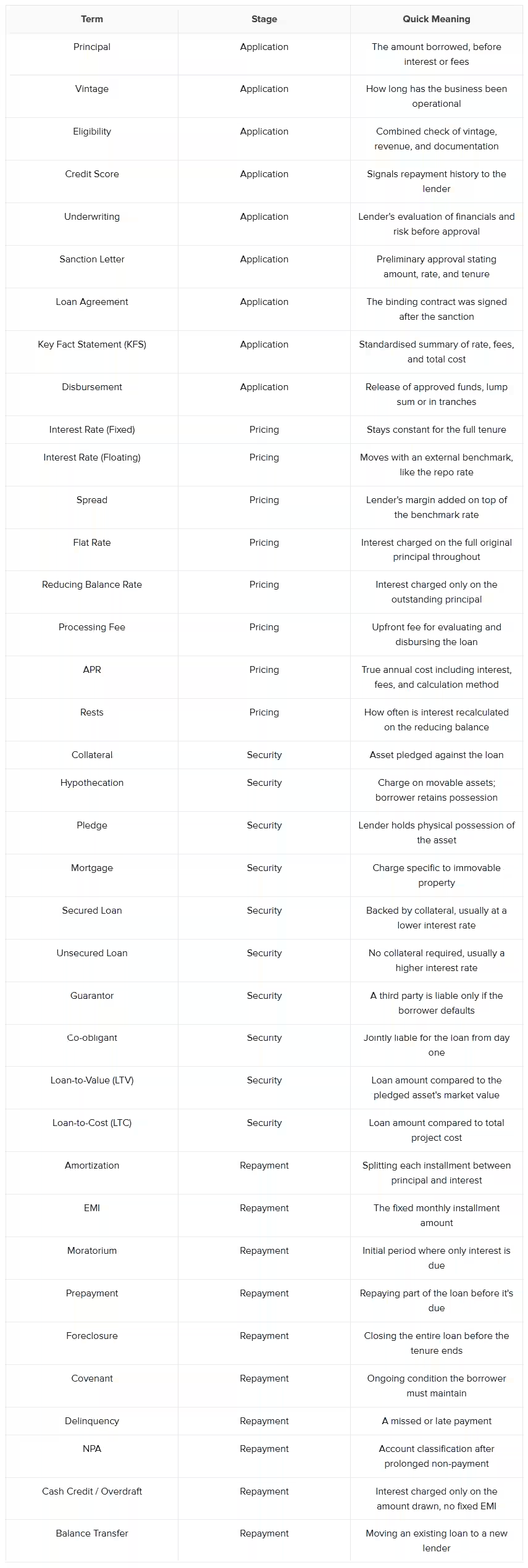
The Complete Glossary at a Glance
Skim this table first if you just need a quick reference. Every term here gets a fuller explanation with real numbers and examples further down in the article.
Why Loan Terminology Trips Up First-Time Borrowers
Lenders don't write term sheets to confuse founders, but each institution structures its language a little differently. A "processing fee" at one bank might appear as an "origination charge" at another. A "guarantor" clause might be buried in an annexure rather than in the main agreement. That inconsistency is exactly why founders need a working vocabulary, not just a document checklist.
Confusion usually shows up at four points in the borrowing process: when you apply, when the lender prices the loan, when security requirements come up, and when repayment terms are finalized. Walking through each stage in order makes the jargon far easier to place and negotiate around.
Terms You'll Meet While Applying for a Loan
Before a lender talks pricing, it needs to establish who you are as a borrower and whether your paperwork supports that. These are the terms that shape approval, not cost.
1. Principal, Vintage, and Eligibility
Principal is the actual amount you borrow before any interest or fees are added. Vintage refers to how long your business has been operational, usually a minimum of one to two years for most lenders.
Eligibility combines vintage, revenue, and documentation quality into a single approval decision.
2. Credit Score, Underwriting, and Sanction Letter vs Loan Agreement
Your business credit score signals your repayment history to lenders. Underwriting is the process a lender uses to evaluate your financials, cash flow, and overall risk before approving the loan. For a closer look at how this evaluation actually works, this breakdown of what underwriting means for growing businesses covers the process step by step.
Once underwriting clears, you'll first receive a sanction letter: a preliminary approval stating the amount, rate, and tenure offered. The loan agreement comes after, and it's the binding contract, so any term that changed between the two documents should be flagged before signing.
Key Fact Statement and Disbursement
The Key Fact Statement (KFS) is a standardised, single-page summary of interest rate, fees, and total cost that RBI now requires regulated lenders to provide before you sign. Disbursement is the release of funds, which may happen as a single lump sum or in tranches tied to project milestones for larger term loans.
Example: A two-year-old D2C brand applying for working capital will typically need GST filings, 12 months of bank statements, and audited financials before a lender even starts underwriting the application, and should expect a KFS alongside the sanction letter.
Once a lender is satisfied with your eligibility, the conversation shifts to what the loan will actually cost you.
Terms That Decide What the Loan Actually Costs
Pricing terms are what can cause two loans of the same size to end up costing very different amounts, often in ways that aren't obvious from the interest rate alone.
1. Interest Rate: Fixed vs Floating, and Spread
A fixed interest rate stays constant for the entire loan tenure, which makes EMIs predictable. A floating rate moves with an external benchmark, typically the RBI repo rate, plus a spread (the lender's margin on top of that benchmark).
Since 2019, banks have been required to link floating-rate loans for retail and MSME borrowers to an external benchmark rather than an internal one, a shift documented in the RBI's Master Direction on Interest Rate on Advances.
2. Flat Rate vs Reducing Balance
A flat interest rate is charged on the full original principal for the entire tenure, even as you repay it. A reducing-balance rate is charged only on the outstanding principal, which decreases with each EMI.
A "12% flat" loan can carry an effective cost closer to 20-22% on a reducing-balance basis, so always ask which method a lender is quoting.
3. Processing Fees, APR, and Rests
The processing fee is charged upfront to evaluate and disburse the loan, typically 1-2% of the loan amount. The Annual Percentage Rate (APR) folds in interest, fees, and the rate calculation method to show the true yearly cost. Rests refer to how often interest is recalculated on the reducing balance, monthly in most business loans, which affects how quickly your outstanding principal actually falls.
Example: A ₹50 lakh loan at 14% interest with a 2% processing fee can cost more in year one than a loan at 15% interest with no processing fee, even though the second number looks higher on paper.
If cash flow is tight, Recur Club's capital experts can help structure repayments around your actual revenue cycle rather than a fixed calendar date.
Pricing tells you what you'll pay each month. Security terms tell you what you're risking to get there.
Terms Around Security and Risk
This is where a lender decides how much of the risk you absorb versus how much they do, and it shows up in both the assets involved and the people legally on the hook.
1. Collateral and Charge Type: Hypothecation, Pledge, Mortgage
Collateral is an asset pledged against the loan, such as property, equipment, or receivables. The legal "charge" on that asset varies by type: hypothecation covers movable assets like inventory or receivables, where you retain possession; a pledge involves handing over physical possession of the asset; and a mortgage applies specifically to immovable property.
Many small businesses assume collateral is mandatory for any meaningful loan size. Government-backed guarantee schemes like CGTMSE exist specifically to help lenders extend collateral-free credit to eligible micro and small enterprises.
2. Secured vs Unsecured, Guarantor, and Co-obligant
A secured loan requires collateral and usually carries a lower interest rate as a result. An unsecured loan skips collateral entirely but often costs more, since the lender is taking on more risk without a backstop.
A guarantor is a third party who agrees to repay the loan if the borrower defaults, while a co-obligant is jointly and equally liable for the debt from day one, not just on default.
3. Loan-to-Value (LTV) and Loan-to-Cost (LTC)
Loan-to-Value compares the loan amount to the market value of the pledged asset; a lower LTV usually signals better terms, since the lender's exposure is smaller relative to the asset backing it. Loan-to-Cost compares the loan amount to the total project cost instead, which matters more for expansion or equipment financing than for working capital.
Security decides what backs the loan. Repayment terms decide how long you stay tied to it.
Terms That Shape Repayment and Exit
Repayment terms determine how flexible the loan feels month to month and where the real friction shows up if your business needs to change course.
1. Amortization, EMI, and Moratorium
Amortization spreads repayment over the loan term, allocating each installment between principal and interest. The EMI, or Equated Monthly Installment, is the fixed monthly payment.
A moratorium, or repayment holiday, is a period at the start of the tenure where only interest is due, useful for businesses expecting delayed revenue from the funded activity.
2. Prepayment, Foreclosure, and the New RBI Rule
Prepayment means repaying part of the loan early. Foreclosure means closing the entire loan out before the tenure ends. Historically, lenders charged 2-5% penalties for either action.
Under RBI's rules on pre-payment charges, effective for loans sanctioned or renewed on or after January 1, 2026, most commercial banks and larger NBFCs can no longer charge prepayment or foreclosure fees on floating-rate business loans to MSEs, regardless of loan size; smaller lenders such as Small Finance Banks retain this waiver only for loans up to ₹50 lakh.
3. Covenants, Delinquency, and NPA
Covenants are conditions attached to the loan, such as maintaining a specific debt ratio or restricting further borrowing, that a business must meet throughout the tenure.
Delinquency is a missed or late payment; if it persists long enough, the account is classified as a Non-Performing Asset (NPA), which affects both the lender's recovery options and the business's future credit access.
4. Cash Credit, Overdraft, and Balance Transfer
A cash credit or overdraft facility works differently from a term loan: interest is charged only on the amount drawn, not the full sanctioned limit, and there's no fixed EMI schedule.
A balance transfer moves an existing loan to a new lender, usually to access a lower rate, and is one of the main reasons the new prepayment rules matter to founders. If you're weighing a structured loan against a working-capital facility, this comparison of working capital loans versus term loans walks through how their repayment structures actually differ.
Knowing each term in isolation helps, but the real test is reading them together on an actual offer.
A Quick Example: Reading These Terms Together
Consider a SaaS company evaluating two offers for ₹2 crore. Offer A: 13% floating rate, unsecured, 1.5% processing fee, 3-year tenure, no covenants. Offer B: 11% flat rate, secured against receivables via hypothecation, no processing fee, 4-year tenure, with a covenant capping additional debt.
Offer A's floating rate looks higher, but as an unsecured, covenant-free facility with no prepayment barrier under the new RBI rule, it's easier to exit early if the business scales faster than planned.
Offer B's flat rate translates into a meaningfully higher effective cost when recalculated on a reducing-balance basis, and it ties up receivables. Neither option is universally better; the right choice depends on whether the founder values flexibility or a lower headline cost more.
How to Use This Glossary When Comparing Loan Offers
Before signing anything, run every offer through the same four checkpoints:
Application fit: Do your vintage, revenue, and documentation match what the lender expects?
True cost: Compare APR on a reducing-balance basis, not just the headline interest rate, across every offer on the table.
Security exposure: Know exactly what's pledged, what charge type applies, and what happens if repayment slips.
Repayment flexibility: Check prepayment terms, covenants, and whether the rate is fixed or floating.
Recur Club connects founders and SME operators with lenders across these structures, and a capital expert is available to walk through how each term applies to a specific offer before you commit.
FAQs
1. What's the difference between interest rate and APR on a business loan?
The interest rate is only the base cost of borrowing. APR adds in processing fees, the flat-or-reducing calculation method, and other charges to arrive at the true annual cost, which is why two loans with similar interest rates can have noticeably different APRs once fees and structure are factored in.
2. Do all business loans require collateral?
No. Many lenders offer unsecured loans based on revenue history and credit score alone, though these usually carry higher interest rates. Secured loans, backed by property, equipment, or receivables, tend to offer lower rates and larger amounts, since the lender's risk is reduced by the pledged asset.
3. What documents do lenders usually ask for during underwriting?
Typically, GST filings, 12-24 months of bank statements, audited financials, KYC documents, and proof of business vintage. Larger loans may also require projected cash flows or a business plan. Exact requirements vary by lender and by whether the facility is secured or unsecured.
4. Is a lower interest rate always the better deal?
Not necessarily. A lower rate paired with a high processing fee, a flat-rate calculation, or restrictive covenants can cost more overall than a slightly higher reducing-balance rate without those conditions. Always compare APR and repayment flexibility together, not the interest rate in isolation.
5. What happens if a business breaches a loan covenant?
Lenders can charge penalties, revise the interest rate, or, in serious cases, demand early repayment of the full outstanding amount, even if EMIs are otherwise being paid on time. Reviewing covenants carefully before signing helps avoid unexpected triggers later in the loan tenure.
6. How is business vintage different from a credit score?
Vintage measures how long a business has operated, usually a minimum threshold lenders set before considering an application at all. A credit score reflects repayment history and creditworthiness and matters regardless of how old the business is, since even a newer business can carry a strong score.
7. Can prepayment charges still apply to fixed-rate business loans?
Yes. The RBI's 2025 Directions on prepayment charges apply specifically to floating-rate loans for individuals and MSEs. Fixed-rate business loans are not covered by this waiver, so lenders can continue to levy foreclosure or prepayment charges on them in accordance with their board-approved policy.
8. What is the difference between a guarantor and a co-obligant?
A guarantor's liability is triggered only if the primary borrower defaults. A co-obligant, by contrast, is jointly and equally responsible for the loan from the start, regardless of whether the primary borrower has missed a payment, which makes the co-obligant's own credit profile part of the lender's assessment.
9. Why does the charge type on collateral matter?
Hypothecation lets you keep using pledged inventory or receivables day-to-day, whereas a pledge means the lender holds physical possession of the asset. Knowing which applies affects your operational flexibility during the loan tenure, not just what happens if you default.
10. How often does a floating interest rate change?
Floating rates typically reset every three months, in line with revisions to the external benchmark, such as the repo rate, to which they're linked. Between resets, the EMI or tenure may be adjusted depending on how the lender has structured the facility.
Related Articles

SME Loans in Chennai: 2026 Guide to Financing
SME Loans in Chennai: from TIIC and NEEDS to CGTMSE-backed private lending, matched to your cluster, whether Oragadam, Ambattur, or OMR.

What Is a B2B Lending Platform? How They're Actually Built and Regulated in 2026
B2B lending platforms in India operate under strict RBI rules governing lender roles, fund flows, and co-lending. Here's how they actually work in 2026.

Term Loans for Business Expansion: A Complete Guide
Choose the right term loan structure for business expansion in India, from equipment loans to large-project financing.
Talk to our experts and find the right financing solution.
Talk to Our Experts →