
A Founder’s Guide to Financial Forecasting for a New Business
Master financial forecasting for a new business: plan revenue, track cash flow, avoid common mistakes, and secure funding efficiently.

Many founders plan growth based on demand, but run into trouble when cash doesn’t follow the same pace. Missed projections can delay hiring, inventory, or even funding conversations.
This gap makes financial forecasting for a new business essential for planning and decision-making. It helps you understand when money comes in, where it goes, and how long your runway lasts.
In this guide, you’ll learn how to build forecasts that support day-to-day decisions and future growth.
Key Takeaways
Forecasts guide growth: Project revenue, expenses, and cash flow to plan decisions and avoid financial gaps.
Key components: Revenue projections, expense forecasts, cash flow, P&L, and balance sheet form the backbone of every forecast.
Step-by-step approach: Define goals, gather data, estimate revenue and costs, create scenarios, and update regularly.
Choose the right method: Bottom-up for startups, top-down for market-level estimates, qualitative for early-stage, quantitative with historical data.
Funding readiness: Accurate forecasts improve credibility, speed up approvals, and Recur Club connects businesses with non-dilutive capital quickly.
What Financial Forecasting Is and Why It Is Important for New Businesses
Financial forecasting estimates a business’s future revenue, expenses, and cash flow based on current data and assumptions. It helps founders plan ahead, anticipate shortfalls, and make informed decisions.
For new businesses in India, this is especially critical. Many SMEs face a funding gap because unclear financial visibility makes it harder to earn trust from lenders or investors. Accurate forecasting helps with:
Cash flow survival: Track inflows and outflows to prevent shortfalls
Fundraising readiness: Demonstrate repayment capacity and growth potential
Growth decisions: Plan hiring, expansion, and inventory with clarity
A clear forecast adds structure to decision-making and reduces financial uncertainty for founders.
Financial Forecasting vs Budgets and Actuals
Financial forecasting estimates your business’s future revenue, expenses, and cash flow using current data and assumptions. Unlike budgets or actuals, forecasts are forward-looking and help founders anticipate challenges, plan decisions, and allocate resources effectively.
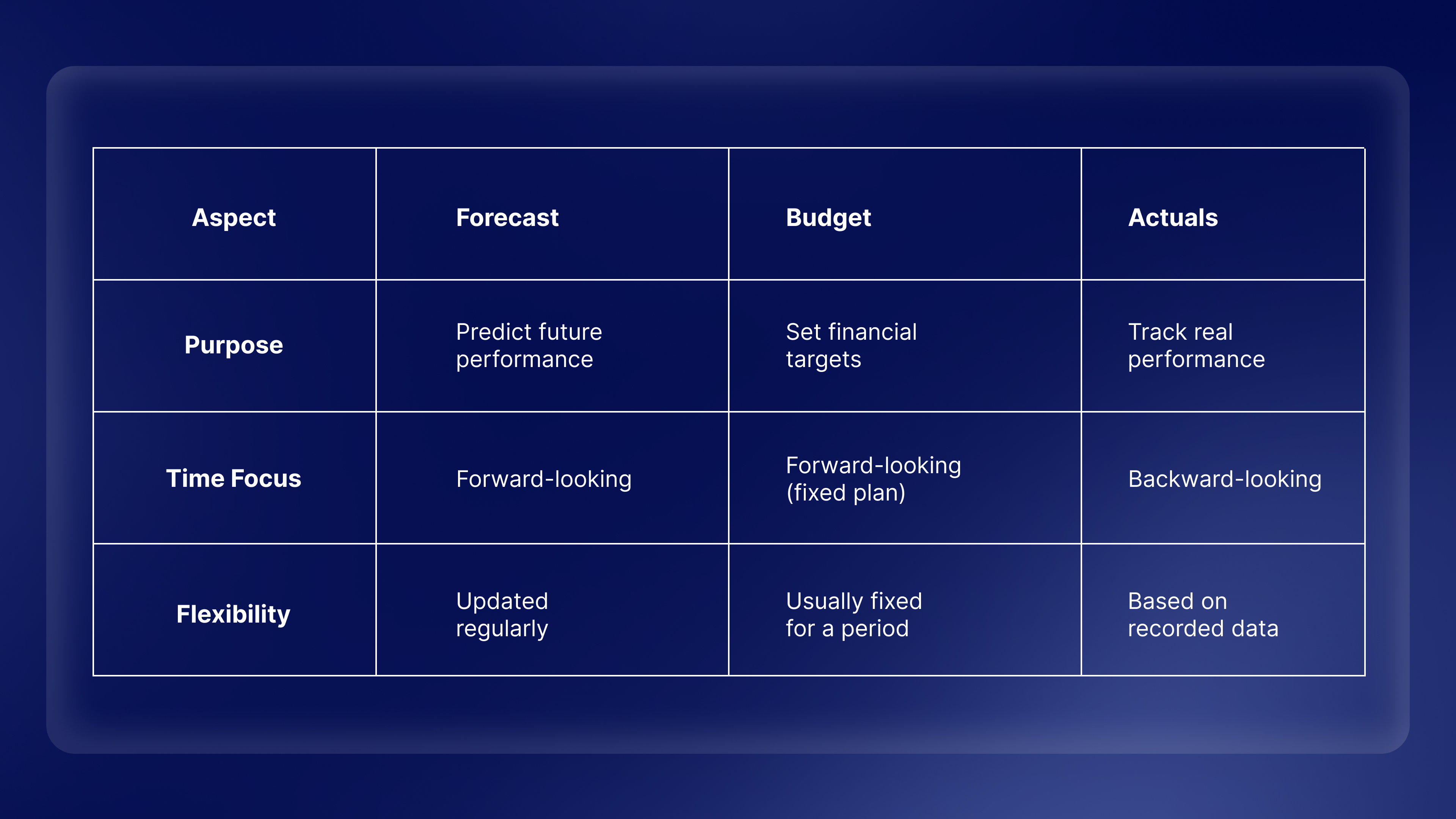
In simple terms:
Forecasts help you prepare for what’s likely to happen
Budgets define what you aim to achieve
Actuals show what has already happened
For founders, forecasting is useful because it connects current decisions with future financial outcomes.
Key Components of a Financial Forecast Every New Business Must Know
A solid financial forecast breaks your business plan into measurable parts. Each component shows how money flows through the business and highlights areas that need attention early.
Revenue Projections
This estimates how much your business is likely to earn. It is based on:
Sales volume assumptions
Pricing strategy
Expected growth rate
Expense Forecast
This outlines what your business will spend to operate. It includes:
Fixed costs: Rent, salaries, subscriptions
Variable costs: Raw materials, logistics, commissions
Tracking both helps in understanding your cost structure and margins.
Cash Flow Forecast
This shows when money comes in and goes out of your business. It helps you:
Identify cash shortages in advance
Plan payments and collections
Manage runway
For new businesses, this is often the most important part, as profitability does not always mean available cash.
Profit & Loss Statement
This summarises your revenue and expenses over a period and helps you assess if the business model is sustainable.
Profit or loss
Overall financial performance
Balance Sheet (Simplified)
This gives a snapshot of what your business owns and owes. It helps founders understand the overall financial position of the business at a given time.
Assets: Cash, inventory, receivables
Liabilities: Loans, payables
Equity: Owner’s stake
Accurate forecasts make it easier to access funding when you need it. Recur Club connects your financial data with the right lenders, helping startups and SMEs secure capital quickly.

Step-by-Step Guide to Financial Forecasting for a New Business

Step 1: Define Your Business Goals
Set clear targets for revenue, growth, and key milestones. Goals provide direction and form the basis of your forecast.
Step 2: Gather Market & Cost Data
Collect information on industry trends, competitor pricing, and operational costs. Accurate data ensures your projections are realistic.
Step 3: Build Revenue Assumptions
Estimate sales volumes, pricing, and expected growth. Base assumptions on market research and historical insights if available.
Step 4: Estimate Costs and Burn Rate
List all fixed and variable expenses. Calculate monthly cash burn to know how long the business can sustain operations without additional funding.
Step 5: Create Cash Flow Projections
Map expected cash inflows and outflows. This highlights periods of potential shortfalls and helps plan for timely funding or cost adjustments.
Step 6: Build Best, Worst, and Realistic Scenarios
Prepare multiple projections to anticipate different market conditions. Scenario planning helps make informed decisions under uncertainty.
Step 7: Review and Update Regularly
Update forecasts based on actual performance and market changes. Regular revisions keep the business aligned with financial realities and growth plans.
Financial Forecasting Methods for New Businesses
Choosing the right forecasting method depends on your business stage, available data, and the purpose of the forecast. Here’s a practical guide for founders:
Top-Down Forecasting
Starts with the market size and estimates your share.
When to use:
When entering a new market
Limited internal data available
Useful for high-level investor presentations
Bottom-Up Forecasting
Builds projections from individual sales, products, or units.
Best for startups:
Early-stage businesses with clear operational plans
Provides more accurate and actionable figures
Helps track cash flow and resource needs
Qualitative Forecasting
Based on expert opinions, market surveys, or management intuition.
Useful for:
Very early-stage ventures with little or no historical data
Testing assumptions before committing resources
Quantitative Forecasting
Relies on historical data and statistical models to predict future performance.
When to use:
Businesses with existing revenue history
Planning for expansion or scaling
Tracking trends and seasonality for better accuracy
Common Financial Forecasting Mistakes New Businesses Make
Even careful founders can run into trouble if forecasts aren’t handled properly. Avoid these common pitfalls:
Overestimating Revenue: Assuming high sales without evidence can lead to overspending and missed targets.
Ignoring Cash Flow: Profit on paper doesn’t guarantee available cash, which can stall operations.
Unrealistic Assumptions: Overly optimistic growth or pricing creates gaps between plans and reality.
Not Updating Forecasts: Regular revisions are essential as market conditions and costs change.
Relying Only on Excel: Manual spreadsheets increase errors and limit scalability.
How Financial Forecasting Helps You Raise Capital Faster
Investors and lenders want a clear picture of how a business will perform. A well-prepared forecast demonstrates:
Cash Flow Clarity: Shows when and how money moves through the business
Repayment Ability: Indicates the capacity to meet loan or investment obligations
Accurate forecasts build credibility, making it easier to secure funding and speed up approval processes. For founders, this means less time waiting and more focus on growth.
Access Capital Without Slowing Growth With Recur Club
While forecasting gives clarity, getting the right capital at the right time is equally important. Many founders struggle to connect with lenders who understand their business needs, which can delay growth or planned initiatives.
Recur Club helps bridge this gap by connecting startups and SMEs with investors and lenders through a streamlined, AI-powered platform. Their offerings include:
Recur Swift: Ultra-fast debt up to ₹10 Crores for startups with ₹5 Cr+ revenue
Recur Scale: Larger debt up to ₹250 Crores for startups & SMEs with ₹40 Cr+ revenue
Revenue-based, working capital, structured loans, and invoice financing with flexible, non-dilutive terms
The platform works quickly: founders sign up, connect financial data, get matched with the right lenders, and can receive capital in as little as 48 hours, without personal guarantees. Get started now!

Final Thoughts
Financial forecasting gives founders a clear picture of cash flow, expenses, and growth potential, helping avoid surprises and make informed decisions. Accurate projections also improve credibility with investors and lenders, speeding up funding when it’s needed most.
For startups and SMEs looking to grow without giving up equity, Recur Club offers advisory-led, AI-powered, non-dilutive capital solutions that connect you with the right lenders quickly. Start building your forecast today and secure the funding your business needs. Connect with our team and access capital in as little as 48 hours.
FAQs
1. What is financial forecasting for a new business?
Financial forecasting is the process of estimating future revenue, expenses, cash flow, and profitability based on market research, business assumptions, and growth plans.
2. Why is financial forecasting important before raising debt or funding?
Financial forecasting helps lenders and investors assess whether your business can generate enough cash flow to grow sustainably and repay capital on time.
3. How do I create a financial forecast for a new business with no historical data?
Start with market research, industry benchmarks, competitor analysis, pricing assumptions, expected customer volume, and estimated operating costs. As real business data comes in, update the forecast regularly.
4. What should be included in a startup financial forecast?
A startup financial forecast should include revenue projections, expenses, cash flow, profit-and-loss estimates, break-even analysis, funding requirements, and the key assumptions underlying the numbers.
5. How far ahead should a new business forecast its finances?
Most new businesses should prepare monthly forecasts for the first 12 months and broader annual projections for the next three to five years.
6. What is the difference between financial forecasting, budgeting, and financial projections?
Financial forecasting estimates future financial outcomes, budgeting sets spending and revenue targets, and financial projections show expected performance under specific business scenarios, often for fundraising or lending discussions.
7. How do lenders evaluate a new business’s financial forecast?
Lenders evaluate whether projected revenue, cash flow, margins, working capital, and repayment capacity are realistic. They also look closely at the assumptions underlying growth, expenses, customer demand, and debt service capacity.
8. What assumptions should I use in my revenue forecast?
Revenue assumptions should be based on pricing, market demand, customer acquisition, conversion rates, retention, sales cycle length, and expected payment timelines. Conservative assumptions are usually more credible than overly optimistic estimates.
9. How can financial forecasting help manage cash flow and runway?
Financial forecasting helps founders see when cash may run short, how long existing capital will last, and when additional funding may be needed. This makes it easier to plan expenses, hiring, inventory, and growth decisions.
10. Can financial forecasting improve my chances of getting a business loan?
Yes. A strong financial forecast can improve your chances of getting a business loan because it shows lenders that your business understands its revenue potential, cost structure, cash flow needs, and repayment capacity.
Related Articles

Capital Investment Growth Strategies for Startup Expansion
Learn capital investment growth strategies businesses use to scale revenue, expand markets, and allocate growth capital effectively.

Common Business Loan Terms Every Indian Founder Should Know
Common business loan terms explained by stage, application, pricing, security, repayment, with real examples, RBI rules, and a quick-reference glossary.

SME Loans in Chennai: 2026 Guide to Financing
SME Loans in Chennai: from TIIC and NEEDS to CGTMSE-backed private lending, matched to your cluster, whether Oragadam, Ambattur, or OMR.
Talk to our experts and find the right financing solution.
Talk to Our Experts →