
CapEx Explained: A 2026 Guide to Capital Expenditure for Startups and SMEs
Explore what CapEx means for startups and SMEs. Learn funding strategies, solutions, ROI insights, and best practices to optimise every capital investment.

You know that moment when your business is growing fast, but your cash flow can’t keep up? Many Indian startups face exactly that. In 2025, total funding for Indian startups declined about 8% to nearly $11 billion. The number of deals also fell, making it harder to secure capital for long-term investments that actually drive growth.
For growing businesses, this creates a clear challenge. You need capital to invest in assets, technology, and infrastructure, but access to funding is limited and often slow. That is why understanding what CapEx means is important not just as a definition but as a practical framework for smarter financial decisions.
In this guide, you’ll learn what CapEx means, how to classify it, how to evaluate investments, and how to fund them without putting pressure on cash flow.
Key Takeaways
- Prioritise Strategic Investments: Focus on CapEx projects that align with growth milestones, maximise ROI, and support long-term scalability.
- Balance Cash Flow and Capital Needs: Plan budgets carefully, maintain liquidity buffers, and combine internal and external funding to avoid financial strain.
- Use Metrics for Smart Decisions: Assess potential returns with ROI and NPV analyses to prioritise high-impact projects.
- Mitigate Risks Proactively: Anticipate delays, asset obsolescence, and financing risks to protect both cash flow and operational continuity.
- Use Technology & Funding Platforms: Platforms like Recur Club help startups and SMEs access funding faster, optimise investment decisions, and turn CapEx into a growth driver.
What CapEx Means for Startups and SMEs
CapEx means capital expenditure, the funds a startup or SME uses to acquire, upgrade, or maintain long-term business assets that support future growth. These assets deliver value over multiple years rather than serving immediate operational needs.
CapEx reflects strategic investment decisions that influence capacity, productivity, and long-term competitiveness. Unlike routine expenses, these investments require careful planning, significant capital, and clear alignment with business goals.
Not every capital investment creates value in the same way. Some accelerate growth, while others can quietly strain cash flow if timed poorly. So what makes the difference? Let’s take a closer look.
Why CapEx Planning is Crucial for SMEs and Startups in India
Effective CapEx planning ensures enterprises invest in the right assets at the right time without straining cash flow or limiting strategic growth. In India, where funding is competitive and capital is often limited, every investment must deliver measurable impact and support long-term objectives.
Here are a few key advantages of planning CapEx strategically:
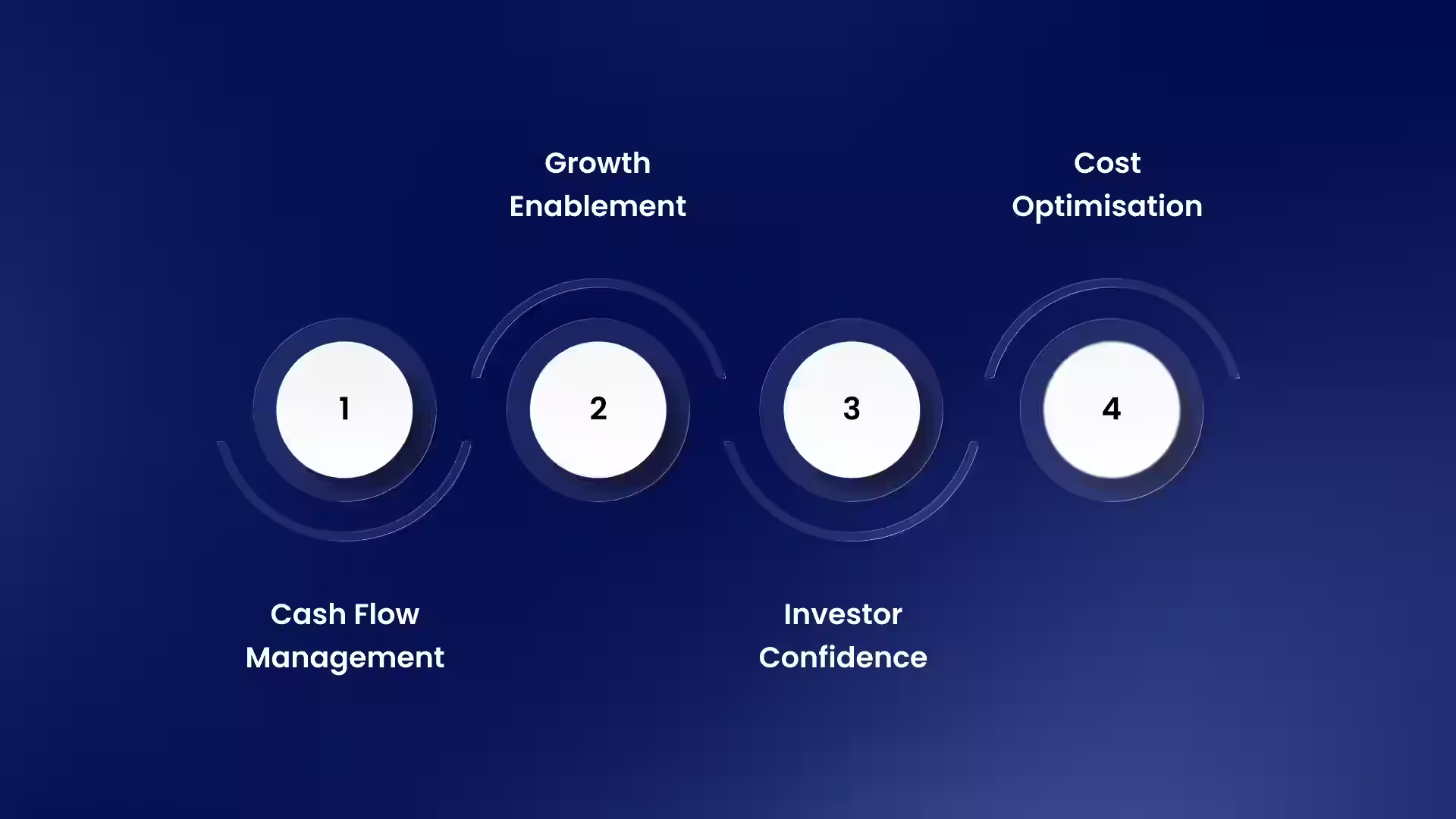
- Cash Flow Management: Access to capital can be inconsistent, and poorly timed investments can create liquidity gaps. Planning CapEx strategically ensures enterprises maintain sufficient cash reserves to meet operational needs.
- Growth Enablement: Properly funded assets, such as production machinery, software platforms, or logistics infrastructure, accelerate service delivery, production capacity, and revenue growth.
- Investor Confidence: A transparent CapEx plan demonstrates financial discipline and foresight, giving lenders and investors confidence in the enterprise’s ability to manage long-term investments.
- Cost Optimisation: Planning and prioritising essential investments prevents overspending on low-impact assets, ensuring every rupee contributes to strategic objectives.
Additionally, growth and late-stage funding accounted for nearly $9.86 billion of total funding in 2025. This indicates that early- and mid-stage startups must plan CapEx carefully to compete for available capital.
Recur Club helps businesses access non-dilutive financing through a data-driven platform, enabling faster approvals and structured capital planning without the stress of cash flow.

A clear plan sets the direction, but execution depends on how investments are structured. Let’s break down CapEx into actionable categories to guide better decision-making.
How to Classify Capital Expenditure for Smarter Planning
Capital expenditure can be categorised based on its impact on growth and ongoing operations. This distinction helps founders and finance leaders prioritise investments, manage cash flow, and align spending with business objectives in a capital-constrained environment.
Here are three key categories that help make more informed CapEx decisions:
1. Growth CapEx: Expansion-Focused Investments
Growth CapEx includes investments that expand business capacity, improve revenue potential, or support market expansion. These decisions are typically made when there is clear visibility into demand and a need to scale operations.
- Examples: Investing in new machinery to increase production output, adopting enterprise software to handle higher volumes, or expanding into new markets.
- How to identify: If the investment is expected to increase revenue or operational capacity, it falls under growth CapEx.
- Cash flow impact: These investments require significant upfront capital and can reduce short-term liquidity, but they are expected to generate returns over time.
- When to prioritise: When demand is strong, revenue visibility is clear, and the business is ready to scale.
2. Maintenance CapEx: Operational Stability Investments
Maintenance CapEx focuses on preserving existing assets and ensuring that operations continue without disruption. These investments are essential to sustain current performance.
- Examples: Replacing worn-out equipment, upgrading systems for efficiency, or improving infrastructure to meet operational requirements.
- How to identify: If the investment maintains current output rather than increasing it, it is maintenance CapEx.
- Cash flow impact: These investments are usually smaller and more predictable, but delaying them can lead to downtime and revenue loss.
- When to prioritise: When asset reliability and operational continuity are critical to maintaining revenue.
3. Development CapEx: Innovation-Focused Investments
Development CapEx includes investments made to build new products, enhance technology capabilities, or create long-term competitive advantage. These decisions are common in startups where growth depends on innovation and product development.
Examples: Building a new software product, investing in platform development, upgrading core technology infrastructure, or funding product R&D initiatives.
How to identify: If the investment is aimed at creating new capabilities, products, or intellectual property rather than immediate revenue or maintenance, it falls under development CapEx.
Cash flow impact: These investments may not generate immediate returns and can create short- to medium-term cash flow pressure, but they are critical for long-term scalability and market positioning.
When to prioritise: When the business is focused on innovation, entering new markets, or strengthening its core product or technology advantage.
|
Growth CapEx drives expansion, Maintenance CapEx sustains current operations, and Development CapEx builds future capabilities, helping founders balance immediate performance with long-term growth. |
Making CapEx decisions can strain cash flow if mismanaged. Recur Club provides fast, non-dilutive funding for operational and long-term investments through a single application, with ₹3,000 Cr+ funded and backing from 150+ lenders. It offers approvals within 48 hours, expert capital advisory, and is trusted by 1,500+ companies.

But even with access to funding, one critical question remains: are you investing in the right assets, or just reacting to immediate operational pressure?
Common and Strategic CapEx Examples for Startups and SMEs
Capital expenditure for startups and SMEs is often shaped by one key constraint: limited capital with high-impact decisions. Founders and finance leaders must ensure that every investment directly supports growth, efficiency, or long-term scalability.
Common CapEx examples include:
- Purchasing machinery to increase production without outsourcing
- Investing in enterprise or workflow software to handle growing operations
- Upgrading office or operational infrastructure to support team expansion
- Buying vehicles or logistics assets to reduce third-party dependency
These investments focus on improving day-to-day efficiency while supporting gradual scale.
Strategic CapEx examples include:
- Expanding production capacity to meet rising demand without losing orders
- Investing in automation or advanced technology to reduce operating costs
- Building or upgrading core product platforms to improve customer experience
- Funding product development to launch new revenue streams
- Strengthening internal systems to prepare for investor due diligence or scaling
These decisions are typically made under cash-flow constraints, with a focus on maximising ROI while minimising financial risk.
Also Read: How to Get Funding to Start a Business: Top Methods to Consider
You can identify the right CapEx opportunities, but without knowing exactly how much capital is being deployed, it’s hard to plan, fund, or track them effectively. Let’s see how CapEx is calculated and measured to make every investment count.
Measuring Your Capital Investments: How CapEx is Calculated
CapEx reflects the amount a company invests in long-term assets, such as property, machinery, or technology upgrades. Tracking CapEx shows how investments support growth, efficiency, and long-term scalability. There are two main ways to calculate CapEx:
1. Direct Method
This method sums all expenditures on new assets and subtracts proceeds from asset sales:
|
CapEx = Total Expenditure on New Assets − Proceeds from Asset Sales |

It gives a straightforward view of net cash outflow related to your capital investments.
2. Indirect Method
This approach uses changes in your PP&E (Property, Plant, and Equipment) balances along with depreciation:
|
CapEx = Net Increase in PP&E + Depreciation |

It’s especially useful for startups and SMEs that want to track how much they’re reinvesting in operations without having to monitor every single transaction.
Components of CapEx Calculation
To calculate capital expenditures, you need to focus on three key components from your financial statements:
- PP&E (Current): Value of property, plant, and equipment on the current balance sheet.
- PP&E (Previous): Value of PP&E from the prior accounting period.
- Depreciation (Current): Annual expense spreading the cost of a fixed asset over its useful life.
Example: If a company purchases equipment for ₹5,00,000 and depreciates it over five years, the annual depreciation expense would be ₹1,00,000. This amount is included in the CapEx calculation using the indirect method.
Here’s a hypothetical calculation of the CapEx for a manufacturing startup in India to upgrade its machinery and facilities. The financial details are as follows:
- Initial Value of PP&E: ₹10,00,000
- New Value of PP&E after Upgrades: ₹12,00,000
- Current Depreciation Expense: ₹50,000
To calculate the CapEx, we can use the formula:
|
CapEx = ΔPP&E + Current Depreciation |

Where:
ΔPP&E = New Value of PP&E - Initial Value of PP&E
= ₹12,00,000 - ₹10,00,000 = ₹2,00,000
CapEx = ₹2,00,000 + ₹50,000 = ₹2,50,000
Result: Thus, the total capital expenditures for the upgrades amounted to ₹2,50,000. This investment reflects the startup's commitment to enhancing its operational capabilities and preparing for future growth.
Also Read: Understanding Quick Ratio: Definition, Formula, and Examples
But how do you know which investments will truly pay off and drive growth? Let’s explore how founders can assess the potential returns and financial impact of every capital decision.
How to Analyse Capital Expenditures for Smarter Growth
For founders and finance leaders in SMEs and startups, evaluating capital expenditures ensures each investment drives growth, efficiency, and scalability without straining cash flow. Here are the key metrics to evaluate CapEx:
1. Return on Investment (ROI)
ROI measures how much value an investment generates relative to its cost. It helps founders decide which projects are likely to deliver the highest returns and which might underperform.

- Positive ROI: Investment returns exceed costs; a green signal for prioritisation.
- Negative ROI: Investment may not be worthwhile; reassess or delay.
- ROI allows comparison between multiple CapEx projects, helping prioritise under tight budgets.
2. Net Present Value (NPV)
NPV accounts for the time value of money by calculating the present value of expected cash inflows from an investment minus its cost. This metric is especially useful when projects have different cash flow timelines.

- Positive NPV: Investment is likely to create value.
- Negative NPV: Investment may erode value; proceed with caution.
- NPV is particularly important for startups and SMEs planning growth or innovation projects where returns may occur over multiple years.
Using ROI and NPV ensures optimal use of scarce capital, prevents liquidity gaps as operations scale, and builds investor confidence by demonstrating financial discipline and strategic foresight.
Also Read: Financial Metrics and KPIs: Measures to Track Success
Even with clear metrics, balancing long-term investments (CapEx) with day-to-day operational costs (OpEx) remains a challenge for many founders. This is where understanding their differences becomes critical.
CapEx vs. OpEx: Key Differences for Founders
While CapEx classification provides structure, its practical impact depends on how these investments are managed relative to operational spending (OpEx). Unlike CapEx, OpEx represents day-to-day costs required to run the business.
The following table highlights the key differences:
|
Feature |
CapEx |
OpEx |
|
Definition |
Investment in long-term assets that support growth |
Day-to-day operational spending required to run the business |
|
Examples |
Machinery, enterprise software, office fit-outs, vehicles |
Salaries, rent, utilities, marketing campaigns |
|
Accounting / Tax |
Capitalised and depreciated; tax benefits spread over years |
Fully expensed in the period; reduces taxable income immediately |
|
Cash Flow Impact |
Significant upfront cash reduces short-term liquidity |
Recurring predictable expense; impacts monthly cash flow |
|
Decision Focus |
Strategic growth and long-term planning (CFOs, Founders, Finance Leads) |
Operational efficiency (department heads, operations teams) |
|
Funding Considerations |
Long-term loans, CapEx funding, internal reserves |
Operating cash flow or short-term credit |
|
Timing & Planning |
Planned quarterly/annually; aligns with strategic growth milestones |
Regular, recurring; budgeted monthly or quarterly |
|
Risk / Implication |
Poor planning can strain cash flow or over-leverage |
Overspending can hurt operational efficiency and profitability |
Managing both CapEx and OpEx without disrupting liquidity can be challenging for growing businesses. Recur Club provides non-dilutive capital personalised to each need, offering term loans for CapEx and working capital for OpEx.

In practice, CapEx strategies can fail if execution risks, funding gaps, or timing missteps are not managed carefully. Let’s examine the key challenges and how to address them.
Overcoming CapEx Challenges: Avoiding Costly Pitfalls for SMEs
For founders and finance leaders, knowing the potential pitfalls before they happen is crucial. From liquidity gaps to misaligned investments, understanding these risks ensures that every capital decision strengthens growth rather than straining resources.
Here are a few key challenges in CapEx planning and ways to overcome them:
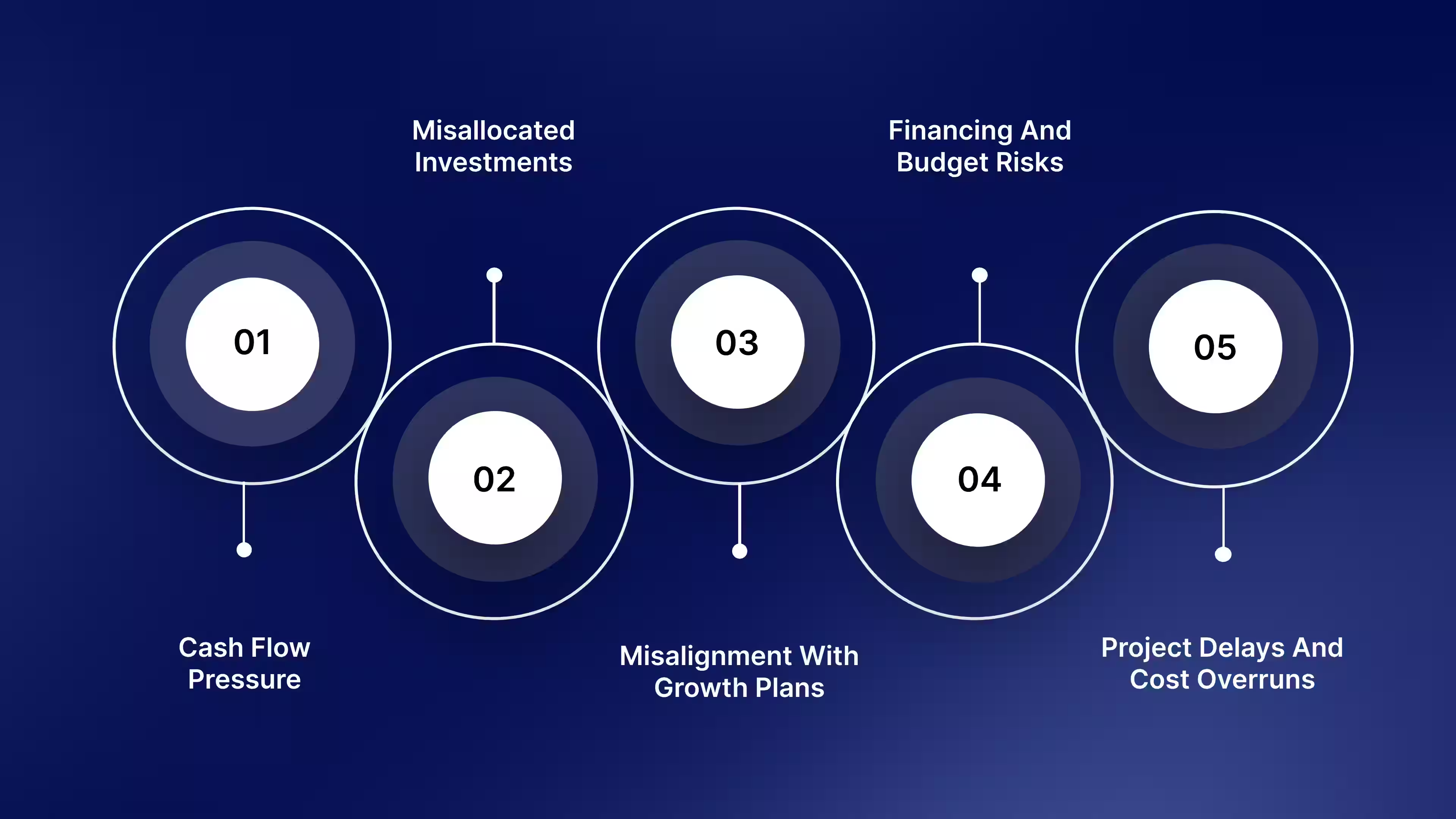
1. Cash Flow Pressure
Investing in machinery, technology, or infrastructure often requires significant upfront capital. For SMEs and startups with tight budgets, this can create liquidity gaps, making it difficult to cover payroll, supplier payments, or unexpected operational costs.
Best Practices:
- Plan a CapEx budget aligned with strategic priorities and revisit it regularly to respond to market or operational changes.
- Prioritise investments with the highest potential ROI to avoid tying up scarce capital.
- Maintain cash reserves or access flexible funding options to buffer liquidity gaps.
2. Misallocated Investments
Over-investing in non-essential assets or under-investing in critical areas can quietly undermine growth. Continuous assessment ensures each CapEx project contributes to revenue or scalability.
Best Practices:
- Conduct regular ROI and NPV analysis before approving CapEx projects.
- Align all capital investments with the company’s short- and long-term strategic roadmap.
- Reassess underperforming assets to redirect resources toward higher-impact opportunities.
3. Misalignment with Growth Plans
CapEx that doesn’t match your business roadmap can stall progress. Expanding production before demand exists or adopting systems your team isn’t ready for can turn strategic investments into wasted expenditure.
Best Practices:
- Map each investment to a specific growth milestone or operational objective.
- Sequence investments based on readiness and projected impact.
- Engage cross-functional teams to validate timing and operational capacity.
4. Financing and Budget Risks
Using loans or external funding introduces repayment obligations and financial strain. Budget constraints, market shifts, or unexpected operational changes can also affect CapEx availability.
Best Practices:
- Carefully balance debt and internal funding to avoid over-leveraging.
- Build contingency buffers in both the budget and timeline to absorb market or operational shocks.
- Monitor spending closely and adjust plans dynamically as conditions change.
5. Project Delays and Cost Overruns
Regulatory approvals, supply chain disruptions, or unforeseen construction challenges can prolong timelines and inflate costs. These issues can turn even well-planned CapEx projects into financial burdens.
Best Practices:
- Include risk assessments and contingency plans for all major CapEx projects.
- Factor potential delays and cost escalations into ROI and NPV calculations.
- Maintain flexibility to reprioritise investments if timelines or costs exceed projections.
For instance, Wellversed, a health and wellness startup, raised ₹6.5 crores through Recur Club in just four days. The structured debt funded operational expansion, boosting revenue by 117% and EBITDA by 63%, while delaying equity fundraising for a better valuation. Read the full case study here!
By identifying these risks early, founders can structure CapEx to maximise returns and protect cash flow, turning every investment into a growth enabler.
Conclusion
CapEx means making strategic, long-term investments that fuel growth without straining cash flow. Every capital decision should be evaluated not just for cost but for its potential to enhance revenue, scale operations, and secure investor confidence. Effective CapEx management requires financial agility and access to reliable funding.
Platforms like Recur Club provide an AI-native debt marketplace for faster access to non-dilutive capital. This allows founders to fund strategic investments with greater control and financial clarity. As a result, startups and SMEs can avoid liquidity gaps and prioritise high-impact growth.
If you’re ready to scale, connect with us today and turn every CapEx decision into a supported growth opportunity.
FAQs
1. How should SMEs prioritise CapEx decisions?
SMEs should prioritise CapEx based on strategic alignment, expected ROI, and cash-flow impact. Growth-driving investments, such as production expansion or technology upgrades, come first, followed by maintenance and innovation projects. Using ROI and NPV analysis ensures that limited capital is allocated to projects that maximise scalability and long-term value.
2. How can startups forecast their CapEx requirements effectively?
Startups can forecast CapEx by mapping growth plans, expected revenue, and operational expansion. Aligning asset purchases with production targets, technology adoption, and market demand ensures smarter spending. Using scenario planning and rolling budgets helps anticipate funding gaps and prioritise investments efficiently.
3. Can startups finance CapEx without external funding?
Yes, startups can use internal cash reserves or reinvest profits to fund CapEx. However, this requires careful planning to maintain operational liquidity. Many startups combine internal funding with short-term loans or lines of credit to balance growth needs with financial stability.
4. How does rapid asset obsolescence affect CapEx planning?
In tech-driven sectors, assets such as software or specialised equipment can become outdated quickly. Startups and SMEs must assess the asset lifecycle before investing, considering resale value, depreciation, and potential upgrades. Strategic timing ensures ROI while preventing unnecessary financial strain.
5. How can SMEs balance CapEx between growth and maintenance needs?
Balancing involves categorising investments as growth-oriented or maintenance-focused. Prioritise growth CapEx for revenue expansion while scheduling maintenance CapEx to sustain operational efficiency, preventing downtime and avoiding surprises that disrupt cash flow.
6. Can CapEx decisions influence a startup’s fundraising potential?
Yes, well-planned CapEx demonstrates strategic foresight, operational efficiency, and financial discipline. Investors and lenders often evaluate CapEx plans to gauge how effectively a startup allocates capital, which can impact funding approvals and terms.
7. Can CapEx investments help reduce your taxable income?
While CapEx itself isn’t immediately tax-deductible, the cost of capital assets can be spread over their useful life through depreciation or amortisation. This allows startups and SMEs to gradually claim tax benefits while investing in growth-critical infrastructure, effectively reducing taxable income over time. Proper CapEx planning ensures you maximize both asset value and tax efficiency.
8. How do unexpected market changes impact CapEx plans?
Shifts in market demand, supply chain disruptions, or funding shortages can affect the feasibility of CapEx. Startups must build flexibility into their budgets, prioritise essential investments, and regularly revisit CapEx plans to respond effectively to changing conditions.
9. Is it better to lease or buy assets for CapEx?
Leasing can reduce upfront capital requirements and preserve liquidity, especially for high-cost equipment. Buying provides long-term ownership benefits and potential tax advantages, but can strain cash flow. The choice depends on financial capacity, asset lifecycle, and strategic priorities.
10. How often should startups review CapEx performance?
Regularly, at least quarterly, to ensure investments deliver expected ROI, align with growth goals, and adapt to changing operational needs. Continuous monitoring helps founders reallocate resources to higher-impact projects.
- What role does investor confidence play in CapEx planning?
Transparent, well-structured CapEx plans signal financial discipline and foresight. Investors are more likely to fund startups that demonstrate careful capital allocation, measurable ROI, and alignment with long-term growth objectives.
- How can SMEs mitigate risks of project delays and cost overruns?
Including contingency buffers in budgets, conducting thorough risk assessments, monitoring suppliers closely, and maintaining flexibility to reprioritise projects are key. Factoring these risks into ROI and NPV calculations ensures that capital investments remain strategic rather than burdensome.
Related Articles

Solving Cash Flow Gaps: The Role of Working Capital Loans for Indian Startups in 2026
Explore when a loan for working capital is useful, its key uses, and how businesses can manage expenses and growth without cash flow gaps.

Confidential Invoice Discounting: Meaning, How It Works, and When to Use It for SME Cash Flow
Understand confidential invoice discounting, how it works, costs, and when SMEs should use it for faster, non-dilutive working capital.

Capital Efficiency: Meaning, Formula, and How to Improve It for Smarter Business Growth
Learn what capital efficiency means, how to calculate it, and how founders can improve it to grow faster without wasting capital.
Talk to our experts and find the right financing solution.
Talk to Our Experts →