
CapEx vs OpEx: The Smart Way to Maximise Profits & Tax Savings
CapEx vs OpEx explained simply. Learn key differences, tax impact, and how to balance both for smarter business growth.

In India, digital lending and faster access to capital have made it easier than ever for businesses to fund both long-term investments and daily expenses. But making the right financial decisions starts with understanding how these expenses are classified.
At the core of this lies a simple distinction: Capital Expenditure (CapEx) is money spent on long-term investments, while Revenue Expenditure is the cost of day-to-day operations.
Knowing the difference between the two is essential for effective financial management. It helps businesses plan budgets more strategically, optimise tax outflows through proper expense classification, and maintain accurate financial reporting. Accurate classification of capital and revenue expenditures drives smarter decision-making, ensuring long-term stability across everything from daily cash flow to high-level scaling.
Key Takeaways:
-
Capital Expenditure (CapEx) refers to long-term investments in assets like buildings, equipment, or technology.
-
Revenue Expenditure (OpEx) includes recurring costs such as salaries, rent, maintenance, and utilities.
-
CapEx is capitalised and depreciated over time, while OpEx is fully charged to the income statement in the same accounting period.
-
A balanced approach to CapEx and OpEx ensures both business growth and operational stability.
-
Recur Club provides fast, non-dilutive capital to fund both CapEx and OpEx needs, with offers within 48 hours, backed by 150+ lenders, and no equity dilution required.
Difference Between Capital Expenditure and Revenue Expenditure: Insights
Capital and revenue expenditures serve different purposes: CapEx creates long-term value through asset building, while OpEx manages daily operational costs. Knowing the difference supports better budgeting, taxation, and reporting.
Here’s a detailed comparison:
|
Aspect |
Capital Expenditure (CapEx) |
Revenue Expenditure (OpEx) |
|---|---|---|
|
Purpose |
Creation or improvement of long-term assets |
Supporting day-to-day business operations |
|
Benefit Duration |
Long-term (more than one year) |
Short-term (within one accounting period) |
|
Accounting Treatment |
Capitalised and depreciated over time |
Fully expensed in the same period |
|
Financial Statement Impact |
Recorded on balance sheet and investing cash flow |
Recorded in income statement and operating cash flow |
|
Frequency |
Infrequent or one-time |
Recurring and regular |
|
Asset Creation |
Creates or enhances assets |
Does not create assets |
|
Tax Treatment |
Tax benefit through depreciation |
Fully tax-deductible in the same year |
|
Cash Flow Impact |
High upfront cash outflow |
Continuous operational cash outflow |
|
Impact on Profit |
Spread over multiple periods |
Immediate reduction in net profit |
How Recur helps with CapEx and OpEx:
CapEx often requires large upfront investments, while OpEx demands consistent cash flow to keep operations running smoothly. For growing businesses, managing both without disrupting liquidity can be difficult.
Recur Club helps businesses access non-dilutive capital tailored to both types of expenses:
|
Use Case |
How Recur Helps |
|
CapEx |
Term loans, structured debt |
|
OpEx |
Working capital, short-term loans |
What is Capital Expenditure (CapEx)?
Capital Expenditure (CapEx) refers to the funds a business spends on acquiring, upgrading, or improving long-term assets that generate value over multiple accounting periods. These are not routine expenses; they are strategic investments aimed at strengthening the company’s capacity, efficiency, and future growth.
Unlike day-to-day operational costs, CapEx creates or enhances assets that continue to deliver benefits beyond a single financial year.
Common examples of CapEx include:
-
Purchasing machinery to increase production capacity
-
Constructing or acquiring buildings and facilities
-
Investing in custom software development for business operations
-
Procuring vehicles for logistics and distribution
Key Characteristics of CapEx:
-
Long-term benefit: Provides value for more than one year
-
High upfront cost: Requires significant initial investment
-
Non-recurring: Occurs occasionally, not regularly
-
Asset creation or enhancement: Results in new assets or improves existing ones
Types of Capital Expenditures
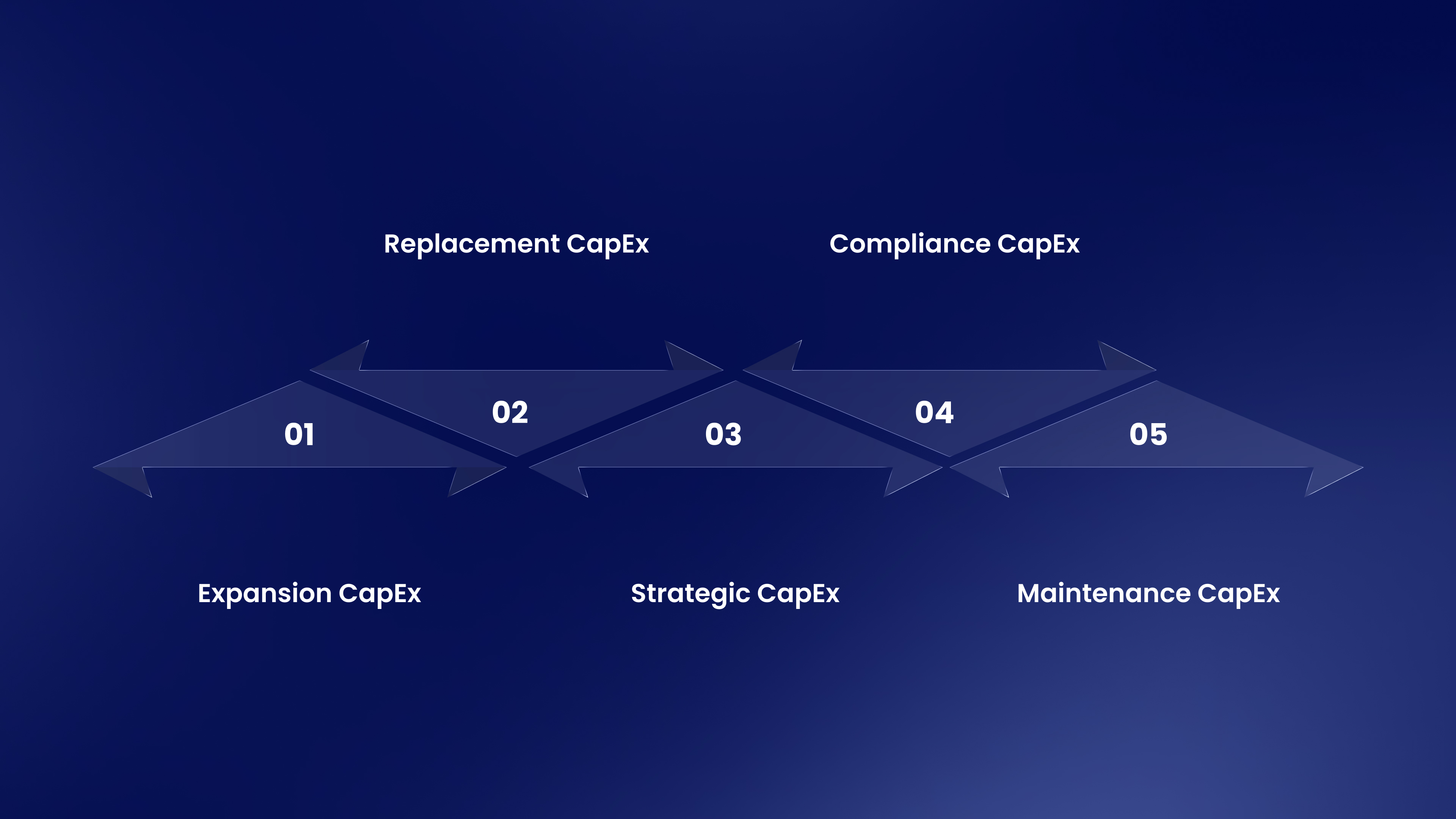
Capital expenditure can be categorised based on the purpose it serves within the business:
1. Expansion CapEx: Investments made to grow the business, such as setting up new facilities, entering new markets, or increasing production capacity.
2. Replacement CapEx: Investments incurred to replace outdated or inefficient assets with newer, more effective ones to maintain performance standards.
3. Strategic CapEx: Long-term investments aligned with business goals, such as research and development, digital transformation, or acquisitions.
4. Compliance CapEx: Spending required to meet regulatory, environmental, or safety standards, ensuring the business operates within legal frameworks.
5. Maintenance CapEx: Investments made to extend the useful life or improve the performance of existing assets. Unlike routine repairs, these upgrades significantly enhance asset longevity or efficiency.
Purpose and Role of CapEx in Business Growth
Capital expenditure plays a critical role in shaping a company’s long-term trajectory. It is about building the foundation for sustained growth and competitiveness.
-
Growth and Expansion: Enables businesses to scale operations, increase capacity, and enter new markets.
-
Efficiency Improvement: Investment in modern technology and equipment helps streamline processes, reduce costs, and improve productivity.
-
Revenue Generation: By enhancing operational capabilities, CapEx directly contributes to higher output and increased revenue potential.
-
Competitive Advantage: Strategic investments allow businesses to innovate, improve quality, and stay ahead in a competitive market.
Accounting for Capital Expenditure
Accounting for CapEx provides a clearer, more realistic view of a company’s financial position, as the cost is spread out rather than expensed all at once. Here’s how CapEx is managed and recorded:
-
Depreciation Over an Asset’s Useful Life: Depreciation spreads an asset’s cost over its useful life as a non-cash expense in the income statement. On disposal, the gain or loss is the difference between its book value and selling price.
-
Appearance on the Balance Sheet: It appears under investing activities in the cash flow loan statement and adds to total assets on the balance sheet.
Also Read: Business Loan Document Checklist for Venture Debt
What is Revenue Expenditures (OpEx)?
Revenue Expenditure (OpEx) refers to the day-to-day operational expenses a business incurs to run its regular activities. These costs are short-term in nature and are fully consumed within the same accounting period, meaning they do not create or add long-term value to assets.
Unlike capital expenditure, revenue expenditure is essential for maintaining ongoing operations and ensuring the business continues to function smoothly.
Common examples of revenue expenditure include:
-
Salaries and wages paid to employees
-
Rent for office or operational spaces
-
Utility bills such as electricity, water, and internet
-
Raw materials used in production
Key Characteristics of Revenue Expenditure
-
Short-term benefit: Provides value within a single accounting period (typically under one year)
-
Recurring in nature: Occurs regularly as part of normal business operations
-
No asset creation: Does not result in the creation or enhancement of long-term assets
-
Direct impact on profit: Fully expensed in the same period, reducing net income immediately
Revenue Expenditures (OpEx) are recurring costs essential for daily business operations. Though they don't create long-term assets, they help manage short-term expenses efficiently and support revenue generation within the same accounting period.

Types of Revenue Expenditures
Revenue expenditure can be broadly divided based on how directly it contributes to production and operations:
-
Direct Expenses (Production-Related):
These are costs directly linked to the production of goods or delivery of services. Examples include raw materials, direct labour wages, and freight charges. -
Indirect Expenses (Administrative/Operational):
These are general business expenses that support operations but are not directly tied to production. Examples include rent, utilities, office expenses, marketing, and administrative salaries.
Purpose and Role of OpEx in Business Growth
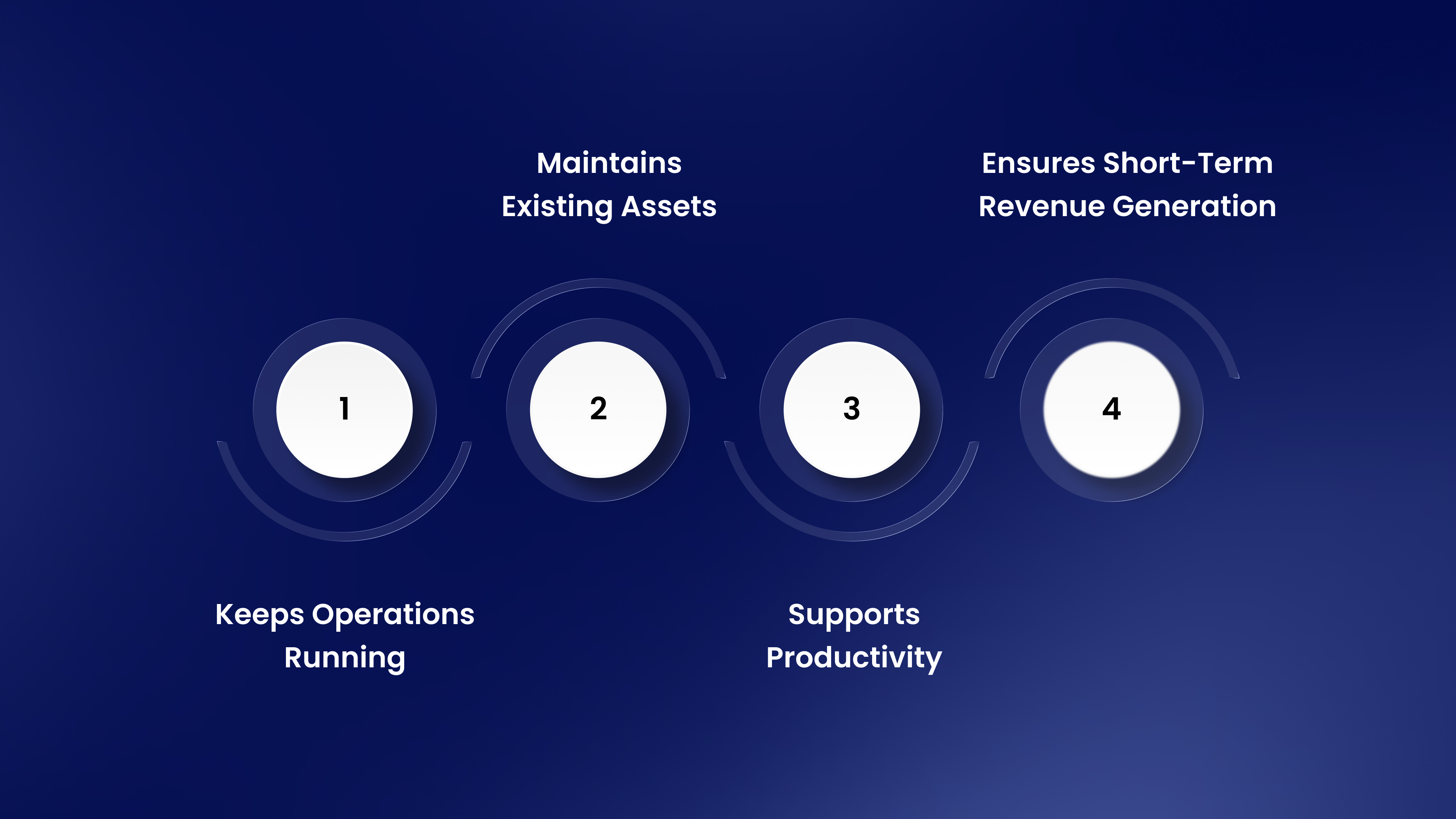
Revenue expenditure is critical for sustaining the day-to-day functioning of a business. While it may not create long-term assets, it ensures that existing resources are effectively utilised and operations run without disruption.
-
Keeps Operations Running: Covers essential costs like salaries, utilities, and supplies required for daily business activities.
-
Maintains Existing Assets: Regular repairs and maintenance help keep equipment and infrastructure in working condition.
-
Supports Productivity: Investment in workforce, tools, and operational resources ensures consistent performance and efficiency.
-
Ensures Short-Term Revenue Generation: By enabling smooth operations, revenue expenditure directly supports ongoing sales and income generation.
Click here to estimate your startup’s funding potential.

Accounting for Revenue Expenditure
Accounting for revenue expenditure accurately reflects a company’s operational efficiency and profitability, as these costs are fully expensed in the period they are incurred. The following points elucidate this notion further:
-
Recorded in the Income Statement: OpEx is recorded in the income statement during the period it occurs, as it supports current operations. These costs aren’t capitalised or depreciated.
-
Impact on Monthly Financials: Since it is recorded immediately, OpEx reduces net income, offering a clear view of monthly profitability.
-
Short-Term Revenue Matching: Fully tax-deductible in the same fiscal year, OpEx lowers taxable income and ensures financials reflect short-term profitability accurately.
Also Read: Understanding Cash Credit: Meaning and Benefits for Business
Common Mistakes to Avoid
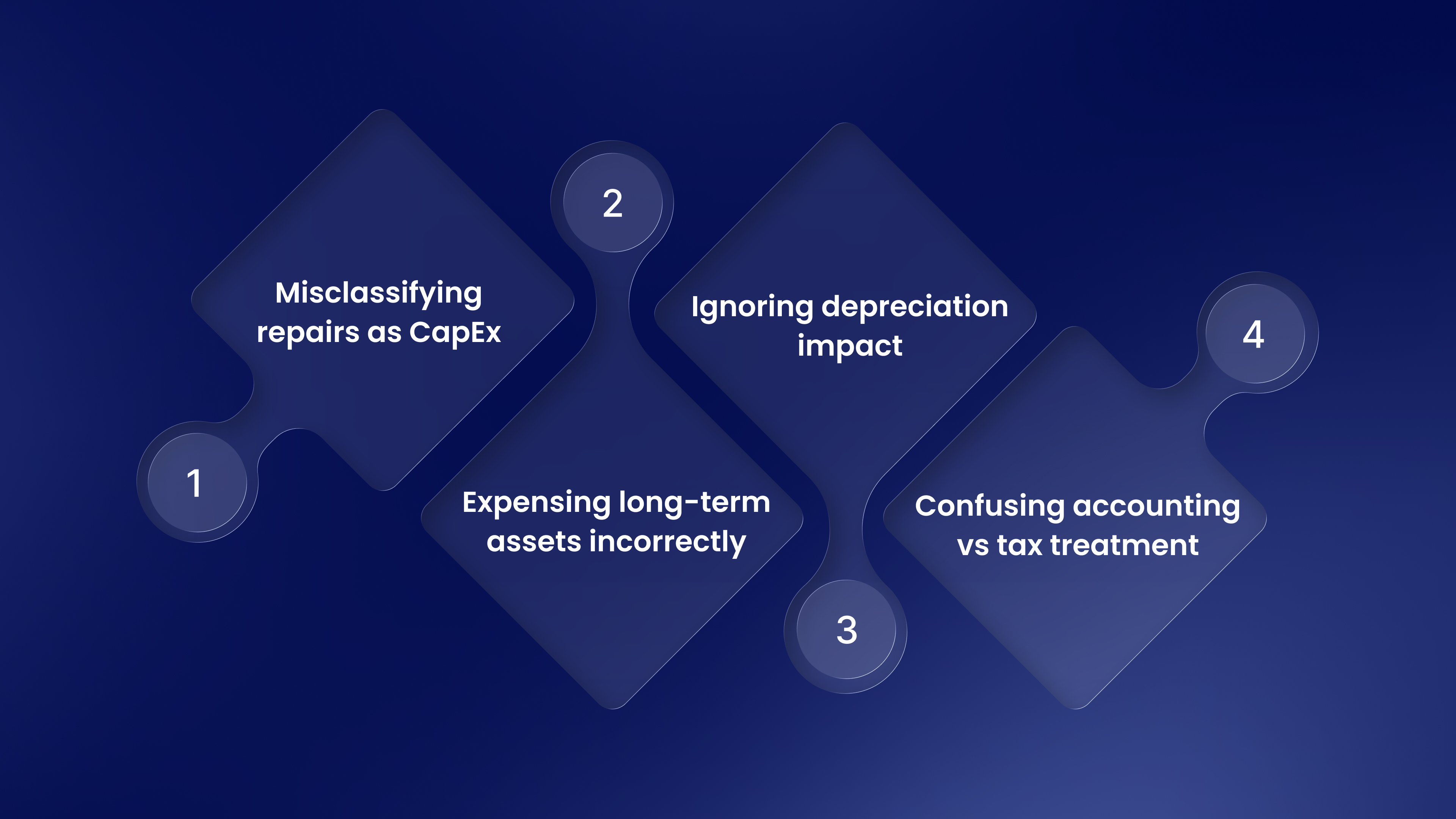
Even with a clear understanding of CapEx and revenue expenditure, businesses often make classification and planning errors that can affect financial accuracy and decision-making.
-
Misclassifying repairs as CapEx:
Routine repairs and maintenance should be treated as revenue expenditure. Only expenses that significantly extend an asset’s useful life or improve its performance should be classified as CapEx. -
Expensing long-term assets incorrectly:
Treating a capital investment (like machinery or software development) as a regular expense can distort financial statements and understate asset value. -
Ignoring depreciation impact:
CapEx is not fully expensed upfront. Failing to account for depreciation can lead to inaccurate profit calculations and poor financial planning. -
Confusing accounting vs tax treatment:
The way expenses are recorded in financial statements may differ from how they are treated for tax purposes. Misunderstanding this can result in compliance issues or missed tax benefits.
Why Balancing CapEx and OpEx Matters
-
Over-investing in CapEx can lead to cash flow issues:
Large upfront investments may strain liquidity, especially if returns take time to materialise. -
Under-investing can limit growth:
Avoiding necessary capital investments can restrict expansion, reduce efficiency, and weaken competitive positioning. -
Strategic allocation is essential:
Businesses need to allocate resources thoughtfully between long-term investments and daily operations to ensure sustainable growth, operational efficiency, and financial stability.
Conclusion
Making strategic CapEx and OpEx decisions is not always simple. Over-investing in one or underfunding the other can impact cash flow and growth. You need capital that supports both, without giving up equity.
Take Wellversed, a D2C health and nutrition brand that partnered with Recur Club to fuel both operational and long-term growth needs. After completing due diligence in just 4 days, Wellversed raised debt six times through Recur Club, totalling ₹6.5 crores, enabling systematic resource allocation and expansion.
The result: a 117% increase in revenue and a 63% rise in EBITDA, alongside the ability to delay fundraising rounds and eventually close them at a higher valuation.
Recur Club connects you with fast, non-dilutive capital to fund your operational needs or long-term investments through a single application. ₹3000 Cr+ funded, supported by 150+ lenders, with no hidden charges.
Why Recur Club?
-
Non-dilutive capital for CapEx and OpEx
-
Offers within 48 hours
-
Backed by 150+ lenders
-
Trusted by 1,500+ companies
-
Expert capital advisory support included
Sign up now or speak to a capital expert to get started.
FAQs
Q. Why are capital and revenue expenditures treated separately?
Capital expenditure builds long-term assets. Revenue expenditure covers daily operations. Recording them separately helps assess growth and operational performance.
Q. Is capital expenditure an expense?
No. It is recorded as an asset and depreciated over time. Only the depreciation appears in the income statement each year.
Q. Can revenue expenditure reduce taxable income?
Yes. It is fully expensed in the same financial year, which lowers the company’s taxable income.
Q. What are some real examples of CapEx and OpEx?
OYO invests in technology and brand assets, which count as CapEx. Boat Lifestyle spends on materials and salaries, which fall under OpEx.
Q. How does Recur Club help with CapEx and OpEx?
Recur Club provides fast, non-dilutive capital based on financials. You can receive funds for both types of expenses within 48 to 72 hours.
Q. Can an expense be both capital and revenue in nature?
Yes, some expenses can have both components. For example, renovating an office may include CapEx (structural upgrades) and revenue expenditure (minor repairs or repainting). These should be recorded separately based on their nature.
Q. Is software considered CapEx or revenue expenditure?
It depends on the type. Custom-built software or long-term system implementation is treated as CapEx, while subscription-based software (SaaS) is usually classified as revenue expenditure.
Q. How does CapEx affect cash flow differently from OpEx?
CapEx typically involves a large upfront cash outflow and appears under investing activities, while OpEx results in smaller, recurring outflows under operating activities, directly impacting short-term liquidity.
Q. Why is depreciation important in capital expenditure?
Depreciation spreads the cost of a capital asset over its useful life, ensuring accurate profit reporting and reflecting the gradual usage of the asset over time.
Q. Which is better for a business: CapEx or revenue expenditure?
Neither is inherently better. CapEx supports long-term growth, while revenue expenditure ensures smooth day-to-day operations. A healthy business needs a balanced mix of both.
Related Articles

Solving Cash Flow Gaps: The Role of Working Capital Loans for Indian Startups in 2026
Explore when a loan for working capital is useful, its key uses, and how businesses can manage expenses and growth without cash flow gaps.

Confidential Invoice Discounting: Meaning, How It Works, and When to Use It for SME Cash Flow
Understand confidential invoice discounting, how it works, costs, and when SMEs should use it for faster, non-dilutive working capital.

Capital Efficiency: Meaning, Formula, and How to Improve It for Smarter Business Growth
Learn what capital efficiency means, how to calculate it, and how founders can improve it to grow faster without wasting capital.
Talk to our experts and find the right financing solution.
Talk to Our Experts →